Photo by Whitehorse Star
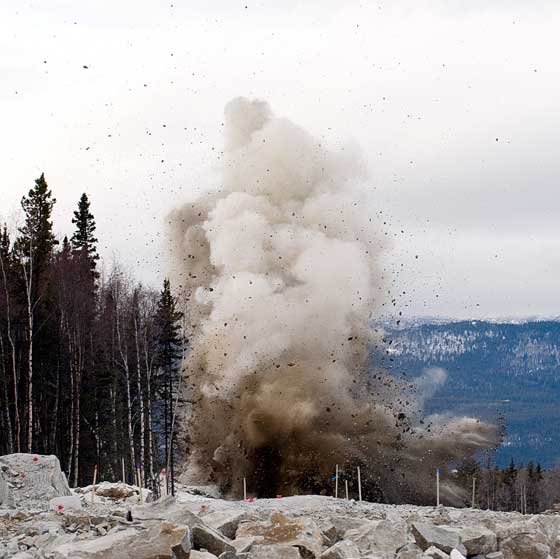
EXPLOSIVE FORCE – Blasting is performed above in November 2007, well before the May 2008 incident that damaged homes in the Lobird Park trailer court. The work was done for the $15- million extension to Hamilton Boulevard.
Photo by Whitehorse Star
EXPLOSIVE FORCE – Blasting is performed above in November 2007, well before the May 2008 incident that damaged homes in the Lobird Park trailer court. The work was done for the $15- million extension to Hamilton Boulevard.
The blaster responsible for setting off the explosion which sent rocks flying into the Lobird Park trailer court in May 2008
The blaster responsible for setting off the explosion which sent rocks flying into the Lobird Park trailer court in May 2008 executed a near-perfect blast, according to his testimony in Yukon Territorial Court this week.
"It worked really beautifully,” Peter Hildebrand said of the blast, which was designed to shatter the rock into pieces smaller than a metre squared and blow them into a pile in the middle of the future road.
Pictures of the blast site show it did exactly that. But it also sent rocks raining down on the trailer court, an unforeseen circumstance could have been caused by a crack or fissure in the rock, the court heard this morning.
The blast's force "will take the easiest route out,” Hildebrand explained, and could lead to rocks being blasted out in unexpected directions.
Photos of some of the blasted rock show discolouration, which Hildebrand said is evidence of an underground fault in the granite.
Hildebrand also said he didn't know how close the trailer park was to his blast site, but guessed based on information given to him by a surveyor working on the site.
Hildebrand took the stand Monday and today in the trial of his employer, P.S. Sidhu Trucking, the Yukon's Department of Community Services, and the project supervisor Bill Cratty – all of whom are charged with allowing an unsafe blast under the Occupational Health and Safety Act and regulations.
The blast occurred during the construction of the Hamilton Boulevard extension on the evening of May 6, 2008.
Hildebrand pleaded guilty to similar charges earlier this month and was fined $1,000 for his role in the incident.
The veteran blaster failed to properly cover the blast area with either mats or sand to prevent rocks from flying up and out from the safety zone, he admitted at his sentencing hearing March 2.
During his testimony Monday, Hildebrand explained he rarely used blasting mats – huge blankets made of tire rubber and steel cable, weighing upwards of 700 kilograms – because they could easily kink or crush the delicate wires connecting the detonators to the explosives.
"I don't like using mats alone because they create more hazards than they prevent,” he said.
Instead, Hildebrand preferred to cover the blast site with a metre of fine sand and clay to prevent fractured rock from flying into the air.
On the day of the offending blast, there was no sand available, Hildebrand said today, and he did not bother to bring any in because the previous 18 blasts he had done on the project had all gone smoothly without.
Flipping through his handwritten blasting log, Hildebrand read out the details of the 19 blasts he conducted on the boulevard extension project between November 2007 and May 6, 2008.
He explained that before each blast, he would draw up a blast design which included the pattern of holes to be drilled as well as the type and amount of explosives.
This design would then be given to Harvey Kearns, the Yukon government site safety inspector, Hildebrand said.
According to the blaster's notes and his testimony, Hildebrand didn't know how close the trailer court was to the construction site.
For the first 11 blasts he did on the project, Hildebrand wrote "not available” under the heading "Nearest structure or utility.”
Although he did fill in the distance on blasts 12 to 19, Hildebrand said he was probably guessing at how far the trailer court was from his blast sites.
According to the facts entered when Hildebrand pleaded guilty, the trailer park is 350 metres from the final blast site, but on Hildebrand's blast report, he estimated it was 1,000 metres to the nearest structure.
Hildebrand was asked repeatedly if he was ever rushed by his boss P.S. Sidhu or supervisor Cratty. He said he was not. He also said the blaster is considered the on-site expert, and is solely responsible for all blasts, as stated in the Occupational Health and Safety regulations.
At the end of his testimony, Hildebrand said he would do things differently knowing the outcome of the blast.
No one was injured in the rock shower which fell on the trailer park the evening of the 19th blast, but judging by the fly rock shown to Judge John Faulkner yesterday, it's a miracle only property was damaged.
Blake Battersby, the owner and manager of the trailer court, described seeing jagged, ham-sized rocks strewn on the 200-street of the neighbourhood on the evening of May 6, 2008.
He took photos of the damage done to homes, trees and sheds.
Many of the rocks had been moved by the time safety inspectors were called to the scene the next day, however.
Kurt Dieckmann, the director of occupational health and safety for the workers' compensation board, also took the stand Monday.
He told the court he was not alerted to the incident until 10:15 a.m. on May 7, 2008.
Dieckmann, who has 10 years' blasting experience himself, said it is imperative for worksite mishaps such as this to be reported immediately "so there's no tampering with the scene.”
He said the workers' compensation board office has a 24-hour answering service which is instructed to call a safety officer if an after-hours report comes in.
By the time Dieckmann arrived at the contruction site at 11 a.m., rocks had been cleared off the roadway and removed from people's homes and yards where they had fallen.
"I immediately noted that the blast site had been disturbed,” he said.
The trial continued this morning.
In order to encourage thoughtful and responsible discussion, website comments will not be visible until a moderator approves them. Please add comments judiciously and refrain from maligning any individual or institution. Read about our user comment and privacy policies.
Your name and email address are required before your comment is posted. Otherwise, your comment will not be posted.
Be the first to comment