Betty's Haven: ‘We need it so badly'
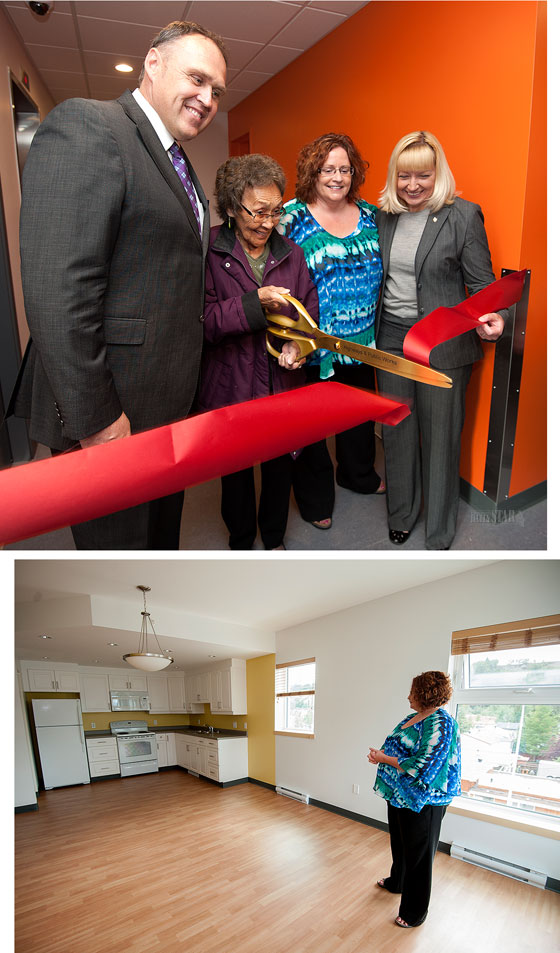
"What a beautiful day,” Betty Sjodin said Monday afternoon, her eyes misting with happiness as she helped officially open Betty's Haven.
By Ainslie Cruickshank on August 27, 2013
"What a beautiful day,” Betty Sjodin said Monday afternoon, her eyes misting with happiness as she helped officially open Betty's Haven.
The new 10-unit supportive transitional housing unit for women and children fleeing abuse is a far cry from the nine-bedroom duplex Sjodin herself first found refuge at 30 years ago.
And she couldn't be more pleased.
"It's just the nicest thing that could ever happen. It's a beautiful building for our women and our children and I just can't say enough about the wonderful work that's been done,” she said.
"We need it so badly. So many times, we've sent women away, and we have to keep giving them only so much time to stay in the apartment so that others can move in and go up to the apartments next door (at Kaushee's Place).
"They are always full; those apartments are never empty for very long.”
The new transition home is named after the Gwich'in elder in recognition of her tireless efforts to support vulnerable women in the territory.
"The staff and myself are really blessed to be able to work with Betty,” said Barbara McInerney, the executive director of the Yukon Women's Transition Home Society, which operates Kaushee's Place and Betty's Haven, during a speech at the opening.
"I've never worked with somebody with such strong morals and yet never brings any judgment to people, no matter where they are or what they've done or where they're at or what they're sharing,” McInerney said.
"That mastery has been brilliant leadership for both myself and the staff.”
Even at 81, and technically retired, Sjodin continues to devote two evenings a week to the women at Kaushee's Place next door, and soon, to the women at Betty's Haven.
During a tour of the new building, McInerney said they'd be able to offer more programming for the women and children with the extra space in their new building.
Kaushee's Place is "quite crammed,” she said.
"It's full to capacity a lot. It's communal living at its most difficult, and here we'll be able to do programming like bring elders in and have more women that have access to beading and traditional medicines.”
Kaushee's Place currently provides 30-day housing for women.
Betty's Haven will complement that as a second stage beyond the 30 days, for up to a year or even longer in some cases, the Star reported earlier this year.
McInerney said she had hoped to have tenants move in before the new school year started.
However, there are a few more security details to be finalized, and furniture is only expected to arrive Wednesday and Thursday.
But tenants will be moving in in the next week to 10 days, she said.
The apartments are bright and modern, the attention to detail clear.
That includes the need for noise barriers, which McInerney noted has been an issue at the affordable housing units in Riverdale.
She couldn't say enough about the contributions by Kobayashi and Zedda, NGC Builders, and many others who all went far beyond what was required and what they were paid for.
The single women will move into the new building first.
The women and children most at risk will remain at Kaushee's Place, where the security is a bit tighter.
"The single women wait a lot longer to get into single housing than anybody else,” McInerney explained.
"The one-bedrooms, they just don't seem to turn over. It is normal for a woman, even given priority, with social housing, to still wait eight, nine months.”
The transitional home "will be an important step for Yukon families working to rebuild their lives and create the future that they deserve in a supportive and secure environment,” Premier Darrell Pasloski said during his opening speech.
The government contributed $4.5 million to the project, which came in on budget and on time.
"We understand that our work is not yet done,” Pasloski said.
"In the coming months and years, we intend to continue to listen to and to work with all of our partners to ensure that the needs of women and children in crisis are met.”
Elaine Taylor, the minister responsible for the Women's Directorate, was also on hand.
"We're all working for one common goal, and that is to ensure that women and children fleeing abuse have a safe and caring place to go to,” she said.
"We know that leaving a situation of abuse takes personal strength and commitment, and it's not easy to leave, but I can tell you that having a welcoming environment and such a stable structure such as this will result in new beginnings for many new families.
"That in itself is worth every penny that has been spent on this particular project and more,” Taylor said.
She also thanked the Women's Directorate and territorial women's organizations.
"Together with the women's directorate, women's organizations have highlighted time and time again the underlying causes of housing insecurity for women, and of course that can include poverty, domestic and family violence, traumatic changes in life circumstances, addictions and the list goes on.
"These perspectives have really helped inform our collaborative work over the many years and led to some incredible experiences, such as what we have here today.”
Kate White, the official NDP Opposition's critic for women's issues, was also at the opening.
"It's phenomenal,” she said.
"It shows community and interest groups coming together to make a dream come true. It's a beautiful, beautiful building, and the opportunity allowed that families that come in here is pretty spectacular.”
The three territories consistently have higher rates of violence against women than the rest of the country.
In 2011, the rate of police-reported violence against women was four times higher in the Yukon than the national average.
According to Statistics Canada, there are multiple reasons for these high rates of violence.
Those include the impacts of systemic discrimination and abuse perpetrated against aboriginal people through residential schools and colonization.
According to the 2009 General Social Survey by Statistics Canada, aboriginal women in the provinces were about 2 1/2 times more likely to experience violence.
They were also more likely to experience the most severe forms of violence, including sexual assault, beatings, choking, and being threatened with a weapon.
Explanations for the higher rates of violence against aboriginal women included socio-economic issues affecting aboriginal communities, discrimination, loss of culture and understanding of their history, residential school experiences and the intergenerational cycle of violence.
Be the first to comment