Bellekeno deposit going back into production
Trucks loaded with silver concentrate should be rolling out of Keno City in a little over a month, says Alexco Resource vice-president Rob McIntyre.
By Chuck Tobin on August 27, 2010
Trucks loaded with silver concentrate should be rolling out of Keno City in a little over a month, says Alexco Resource vice-president Rob McIntyre.
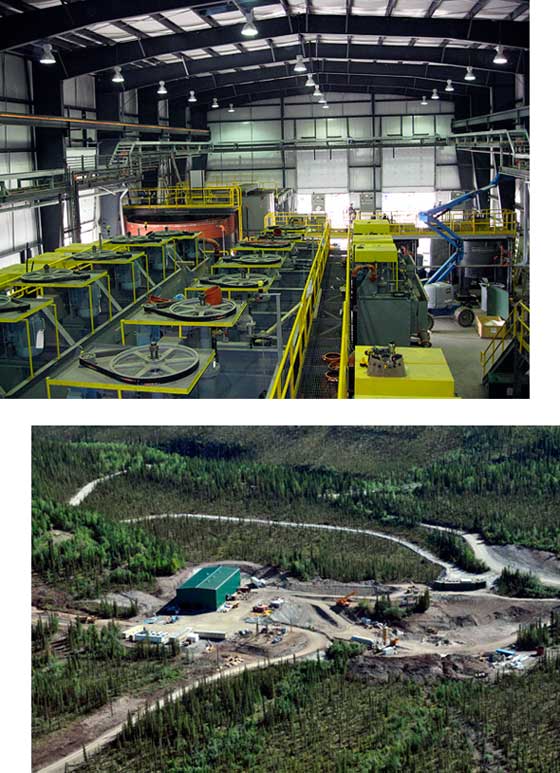
McIntyre said with the water licence for the Bellekeno project issued this week, all lights are green, and the company is almost ready to fire up its new mill and begin processing ore.
"We expect within the next four to six weeks we will be there,” he said in an interview Thursday.
The Yukon Territory Water Board issued the 10-year licence Monday, subject to several conditions.
In 23 pages of reasons explaining the decision, the board indicated some concerns raised by local Keno City residents were not within its mandate address.
The board said it was, however, satisfied Alexco's water management plan was sufficient to protect the environment and the source of underground fresh water which supplies wells in the small community.
McIntyre said there will be 120 employees to run the mine and mill, working rotating shifts of approximately two weeks in and 10 days out.
Currently, there are about 150 on site, mostly contractors who specialize in mill and mine construction.
McIntyre said hiring for full-time operations, both locally and outside the Yukon, has been quite successful so far.
Alexco is offering financial incentives to employees who choose to live in the Yukon, and even more for those who reside in Mayo, he noted.
The company, McIntyre added, wants to maximize what it puts into the local economy, and if it can encourage employees to live here rather than fly out on their rotation, it's better for everybody.
He said as it is, Alexco estimates it will spend $25 million annually on labour, materials and supplies, and it wants to add to that anyway it can.
The company estimates it will have spent $61 million, including the cost of the new mill, to the Bellekeno deposit into production.
The life of the mine is currently estimated at 3 1/2 years at about 2.8 million ounces of silver a year, though the company fully expects that number will go up with ongoing exploration, McIntyre said.
He pointed out the company is also drilling at several other locations.
Alexco's objective, the vice-president added, is to discover as much new silver as it takes out of the ground.
There are already known deposits like the Silver Queen, the Lucky Queen and Onek, or Keno spelled backwards, McIntyre said.
He said the Silver Queen is a high-grade deposit, and even has pockets of pure silver.
But its overall tonnage of paydirt right now would not warrant relocating the mill, which was designed so that it could be taken down and moved to other deposits in the district, McIntyre said.
In fact, he pointed out, Alexco has yet to uncover any deposit which would warrant moving the mill, though its exploration program is intensive, with a budget this year of $20 million, compared to $13 million last year and $9 million the year before.
"Every ounce we take out, we want to replace through exploration.”
The Keno Hill silver district is still a hot ticket, McIntyre insisted.
"All the oldtimers say ‘Ah, you guys have not hit the high grade yet.'”
It's expected the number of tractor-trailer units leaving every day for the smelter in Trail, B.C. will increase from three to five or six when production peaks in a year or so.
Mining in the Keno Hill silver district shut down in 1989, when the price of silver dropped to $4.89.
Various attempts through the 1990s to restart mining and milling in Elsa failed, and the operation was declared abandoned in January 2001 by the federal government, which took over care and maintenance of the water treatment system.
Alexco Resource earned control over the known deposits and a total of 800-plus mineral claims through bankruptcy proceedings which involved a commitment by the company to help clean up and reclaim the remains of nearly a century of mining.
It was recognized as a landmark arrangement. Up until then, Ottawa insisted that any company wanting to move in for the gravy would have to accept responsibility for all existing liabilities – tailings, exposed waste rock and so forth.
The federal government eventually relinquished its position, and agreed to award Alexco the assets while keeping Canadian taxpayers on the hook for the abandoned liabilities.
For its part, however, Alexco promised to help develop and execute a reclamation plan, as well as contribute more than $10 million to the estimated $65 million to complete the work.
The reclamation plan is still under development, but is expected to be ready next year to enter the environmental review process.
It's been a whirlwind affair so far, said McIntyre, adding it began with Ottawa finally agreeing to sever the assets from the liabilities.
"It's quite possible we are unique in the world,” he said. "Three years from exploration to production, including all licences and permits, is staggeringly fast.”
Normally, McIntyre pointed out, it takes seven years on average to go from drilling holes in the ground to producing product.
He said everybody was confident from the outset that there was still lots of silver in the ground, but Alexco had to start from scratch to prove it because exploration records left behind in the bankruptcy were not up to modern day stock market standards.
Pivotal to Alexco's success was the $50-million contribution agreement it signed in October 2008 with Silver Wheaton, in exchange for future sales, he said.
McIntyre said as the world was free-falling into economic recession, with investment capital disappearing at breakneck speed, Alexco was securing critical financing to advance its project.
Today, he insisted, the Bellekeno endeavour is rock-solid economically.
McIntyre said Alexco estimates it will cost $2.96 U.S. to produce an ounce of silver. Silver was selling Thursday at just under $20 an ounce.
"That's a nice margin,” he said of the company's ability to weather fluctuations in the price of silver or increases in production costs related to higher fuel prices or other factors.
Bellekeno is scheduled to become the Yukon's second hardrock mine in production.
The Minto Mine began commercial production at its open pit operation northwest of Carmacks in the fall of 2007.
Records indicated 217 ounces of silver were mined in the district between 1921 and 1988.
Comments (2)
Up 0 Down 0
David Hedmann on Aug 29, 2010 at 7:02 am
you meant 217 ?? ounces of silver?
Up 0 Down 0
glen fenwick on Aug 29, 2010 at 5:21 am
We need the industry and it sounds very good, let's hope our history of
"rape and pillaging the land" doesn't repeat itself... Good luck