Photo by Vince Fedoroff
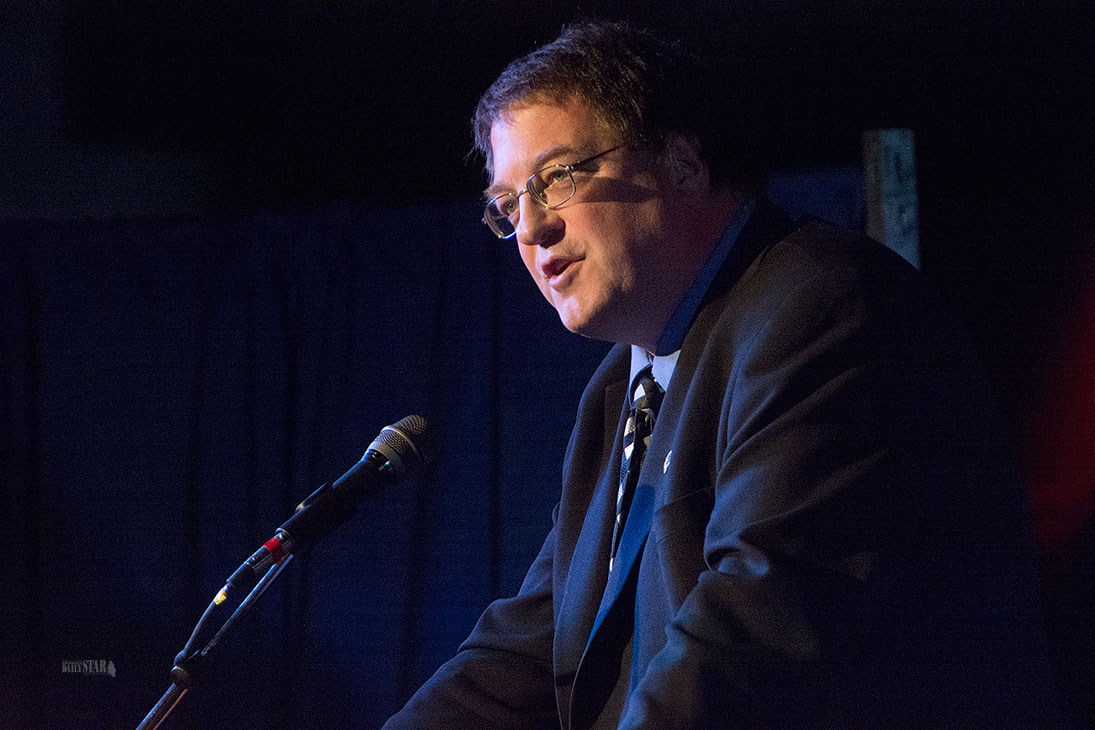
SEIZING THE MIDNIGHT SUN – Ken Coates, raised in Whitehorse and a renowned historian of the North, told business conference attendees this week to ʻseize the imagination of the world.ʼ
Photo by Vince Fedoroff
SEIZING THE MIDNIGHT SUN – Ken Coates, raised in Whitehorse and a renowned historian of the North, told business conference attendees this week to ʻseize the imagination of the world.ʼ
Ken Coates did not pull his punches at a gathering of business leaders this week.
Ken Coates did not pull his punches at a gathering of business leaders this week.
“Here’s the reality: Canadians have gone soft,” he said during his keynote speech on the final day of the Opportunities North Conference.
“We’re turning our backs on the frontier experience.”
The Whitehorse-raised historian and respected authority on northern issues was not lambasting northerners; rather he was accusing those from Outside of shying away from the ruggedness that has defined much of Canada’s past, and which continues to shape communities above the 60th parallel.
However, Coates also suggested businesses and governments in all three territories are not doing enough to exploit their strengths, and need to stir more boldness and creativity into their recipes for economic development.
“We have a chance to build a real northern future, or to have it built for us,” he told the audience at the Yukon Convention Centre Wednesday afternoon.
“Northern Canada has to take the lead on getting Canadians to embrace the North.”
Coates, who holds the Canada Research Chair in Regional Innovation at the Johnson-Shoyama Graduate School of Public Policy in Saskatchewan, said high-tech firms and post-secondary institutions were two paths to unique growth.
He pointed to universities in the relatively remote northern cities of Skelleftea, Sweden, and Tromso — north of the Arctic Circle — in Norway as well as Fairbanks, Alaska.
He also said Canada is the only country out of eight that border the Arctic which does not have any universities in the jurisdictions abutting it.
Coates highlighted the North’s inherent climatic advantage in the world of high-tech business. He said the Yukon could follow the lead of places like Lulea, Sweden, a high-tech hub for the past 20 years.
Facebook announced in 2011 it would build its first data centre outside the U.S. in Lulea.
On the same day that Coates gave his speech, coincidentally, the government released a report on the territory’s potential as a location for data centres – storage facilities for vast amounts of digital information.
The study touted the Yukon as an ideal site for the outsized warehouses due to the area’s frigid air and water, which could cool the digital hotspots at relatively low cost.
Mimicking Scandinavia should only go so far, Coates cautioned: “Draw the line at running naked from the snow to the sauna – I think that’s kind of gross.”
He noted Norway, Finland and Sweden have been ramping their resource industries back up and are looking to Canada as a “model” of community consultation and environmental assessment.
He also pointed out – like the previous day’s keynote speaker Perrin Beatty, president and CEO of the Canadian Chamber of Commerce – that northern natural resources are not just a northern industry.
“There are more jobs created in the resource sector in Toronto than in all three territories combined.” Thus, it is in the national interest to extract them, he suggested.
Nonetheless, he stressed the need to push the North past its perception in the national consciousness as “Canada’s attic, a treasure trove where the country occasionally reaches up and grabs things.”
To do this, he encouraged strengthening the Yukon’s trade and immigration ties to Asia.
The Yukon’s Nominee Program, introduced in 2007, has become a common entry-point for Filipino immigrants, who now number more than 2,000 in the territory.
Coates asked attendees at the conference — themed “Pushing Boundaries” — whether the region could “explode our single most important boundary”: the line dividing aboriginal and non-aboriginal residents.
He expressed admiration for the “optimistic” attitude inherent in First Nations’ continued willingness to meet with governments and shareholders despite the “burdens” of residential schools, dislocation and colonialism, as well as the dubious results of more recent consultations.
“We must know that the past is important, but that we must not be saddled by it,” said the author of multiple histories of the North.
Coates concluded that the region needs “to overthrow expectations.
“We have the opportunity to seize the imagination of the world.”
In order to encourage thoughtful and responsible discussion, website comments will not be visible until a moderator approves them. Please add comments judiciously and refrain from maligning any individual or institution. Read about our user comment and privacy policies.
Your name and email address are required before your comment is posted. Otherwise, your comment will not be posted.
Comments (2)
Up 2 Down 3
steve on Oct 14, 2014 at 12:53 pm
Common sense indicates if you pour liquid chemicals into the group as a liquid they will flow down and mix with the water table. It's called gravity. Show me where fracking has been done and there is no contamination of the water table over the last 20 years. I am sorry but, I think clean water is more important to locals than shipping off fracked natural gas to China. You may want to poison your water but, we have a obligation to protect our water not only for our children but, the animals and environment.
Up 2 Down 5
Stronger Economic Ties on Oct 14, 2014 at 9:58 am
Yukon, Alaska, Northern BC need to develop closer economic ties in the planning and development of their economies. For example, energy is a great opportunity in the short and long term especially hydro and export of energy. There is lots of discussion on fracking for natural gas. AB, Sask. BC. Alaska and the NWT all have and are permitting fracking and other types of drilling. They have the science, knowledge and experience to show fracking is part of their future and in their best interest for their economy.
Look at Alaska, Canadian firms own the larger mining projects in Alaska. Canada has a major asset and we have the strongest mining experience in the world and are involved in a lot of projects around the world. The people of the world enjoy the success of these mining companies every day by driving our cars, hospital equipment that looks after our health.
The speaker talks about the northern countries in Europe and how they are moving their economies forward. When I was growing up in Nova Scotia a company from Sweden came to Canada and built a very large pull mill in 1956. It employed 2800 people. A lot of my family members spent a life time working in this business and made good incomes and retired. Because of the internet, these businesses are not profitable any more so things have to change. The Yukon and the northern partners have to look at and understand our future. It is sad when a government puts out a process on fracking and it cannot do its job and deliver on its mandate because of people who do not bring any common sense to the table. This is not what the Yukon is about. We are about continuing environment management like the YESSA, progress, solid economy, jobs and life style for the future for our children.