Photo by Whitehorse Star
KIRSTIE SIMPSON
Photo by Whitehorse Star
KIRSTIE SIMPSON
By next winter, people using the Yukon's backcountry will have an avalanche forecasting team to warn them of risks in the territory's most-played in mountains.
By next winter, people using the Yukon's backcountry will have an avalanche forecasting team to warn them of risks in the territory's most-played in mountains.
Thanks to a $658,000 grant from the National Search and Rescue Secretariat, the Yukon Avalanche Association (YAA) will be filling three full-time seasonal positions – a project manager and two professional avalanche technicians.
They will collect and deliver snow pack and weather data to the Canada Avalanche Centre's Revelstoke, B.C. office.
There, a forecaster will create weekly avalanche predictions and post them on the centre's website, www.avalanche.ca.
The YAA said it is also buying two remote weather stations and one remote snow survey station which will deliver "reliable and timely weather data.”
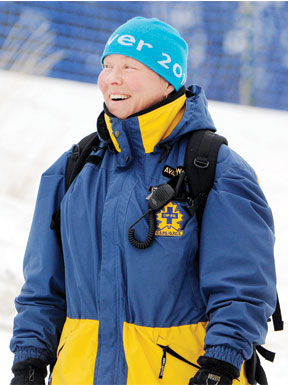
"It's kind of become the standard across Canada,” YAA president Kirstie Simpson said today of why the association wanted to create a Yukon forecasting system.
"People who go into the backcountry are used to seeing forecasting.... It will give them information on stability of the snow and help them decide if they want to go.”
The forecasts will focus on the White Pass and Wheaton River Valley areas, where the majority of backcountry users go.
Two people have lost their lives to avalanches in the Yukon since 2005.
The first was Jessie Aulik, a 22-year-old Calgary woman, who was pulled down Mount Logan by a slide in May 2005.
The other was Honza Galac, who died in Kluane National Park last April when an avalanche swept him and a fellow skier down the north face of Observation Mountain.
"We've had some significant involvements this year – two full burials,” Simpson said, referring to a skier who was buried by an avalanche in the White Pass and a snowmobiler buried in the Wheaton River Valley this past winter.
Both slides could well have been predicted by a well-informed forecaster, she said.
"In fact, both were related to some significant weather events, and would have been easy captures.”
Avalanche forecasting is based on a "triangle” system, Simpson explained, representing three factors: terrain, snow pack and humans.
Avalanche terrain is any slope between 30 and 45 degrees, with south-facing slopes being particularly unstable due the heat of the sun.
Snow pack is affected by weather events such as rain, wind and the type of snow that is falling, all of which can create unstable layers of weak or sugary snow, hard-pack and ice.
Humans are the final factor, as we can trigger slides on unstable ground.
"Basically, if you take away any side of the triangle, you don't have any avalanche concerns,” Simpson said.
The two-year project will cost $885,000, according to the YAA, with the remaining money coming in the form of in-kind donations.
The YAA, created in 2009, provides training and public education for those who use the backcountry.
In order to encourage thoughtful and responsible discussion, website comments will not be visible until a moderator approves them. Please add comments judiciously and refrain from maligning any individual or institution. Read about our user comment and privacy policies.
Your name and email address are required before your comment is posted. Otherwise, your comment will not be posted.
Be the first to comment