Photo by Whitehorse Star
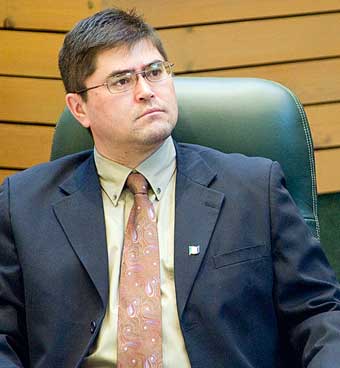
Liberal Environment critic Darius Elias
Photo by Whitehorse Star
Liberal Environment critic Darius Elias
An internal auditor's report released at the end of 2010 urges a major review of the Yukon's Environment Act
An internal auditor's report released at the end of 2010 urges a major review of the Yukon's Environment Act and highlights a raft of shortcomings that compromise safe fuel storage and consistent and adequate water testing at mine sites.
Prepared by the Yukon government's audit services branch, the report's findings suggest environmental monitoring practices are not currently capable of safeguarding the territory's land and water.
"Examples of resource limitations and inadequate systems that resulted in permitting and inspection activities which were not within a tolerable standard of efficiency, accuracy, consistency and completeness,” the report concludes.
"In respect of fairness ... the government had not yet reached the point where the monitoring and permitting standards were consistent across the board.”
With the Yukon experiencing mining activities – exploration and extraction – not seen since the late 1980s, Liberal Environment critic Darius Elias said the government is neglecting its obligation to safeguard the environment.
"Our Environment Act is not being well managed; that's what this report concludes, and its a concern to me and I think it's a concern to Yukoners,” Elias told the Star.
"When I see the dates of 2005 recommendations all over this report that have still not been addressed ... it's proof to me the environment is not very important to this government.”
The internal auditor's "recommendation #B2”, for example, reiterates what was reported in similar 2005 and 2008 audits – that "the Yukon government should review the Environment Act in light of the substantial governance changes since 1991.”
In the two decades since, major land claims have been signed, delineating responsibilities for land use planning and environmental management, as well as devolution, which transferred province-like responsibilities from the federal to the territorial government.
Another recommendation in the 2010 performance audit – also a holdover from previous reports – urges the department to "review its policy for designating contaminated sites to ensure that it complies with ... and is meeting the fairness criterion ... with respect to prevention of environmental harm and freedom of
information.”
Environment Minister John Edzerza did not respond to the Star's request for an interview on the report, and Elias is not surprised by the minister's silence.
"We've raised this in the legislature before,” said Elias. "And the minister has an obligation to keep the public informed and he's not.”
During the fall sitting of the legislature, NDP MLA Steve Cardiff also questioned the rigour of water testing at mine sites, much of it under the auspices of the Department of Energy, Mines and Resources (EMR).
But EMR Minister Patrick Rouble defended his department's inspectors and accused Cardiff of sullying their reputation.
"To impugn (inspectors) because they're working for one department or another means that they're going to take their job less seriously is just, frankly, offensive,” said Rouble.
In the wake of Cardiff's and Rouble's exchange, bureaucrats within the both departments – Environment and EMR – also stood by such inspections though their comments appear in direct contradiction with the auditor's report.
Since the late 1980s, EMR has conducted water quality tests for the federal Department of Fisheries and Oceans (DFO), and four years ago, it took over water testing at the Minto Mine site.
The Environment department continues its responsibilities for monitoring all water use at the Wolverine and Bellekeno mines.
Rob Thomson, EMR's client services and inspections director, said his inspectors are trained to do the same testing that Environment department inspectors would do in similar circumstances.
"And if there is a particularly specialized issue that needs technical assistance, we may attend a mine with biologists from DFO or a specialist from Environment,” said Thomson, who disputed that water testing by EMR is done with the mining industry's best interests in mind.
"And we have no role in promoting economic development,” he added.
Kevin McDonnell, a director with Environment's water resources branch, said auditing and monitoring are in place to ensure proper water sampling is done.
"We have no reasons to think there's any problems with what's being done by Energy, Mines and Resources ... our approach is to work with them,” said McDonnell.
"And there's nothing to believe there's any problems.”
In order to encourage thoughtful and responsible discussion, website comments will not be visible until a moderator approves them. Please add comments judiciously and refrain from maligning any individual or institution. Read about our user comment and privacy policies.
Your name and email address are required before your comment is posted. Otherwise, your comment will not be posted.
Be the first to comment