Photo by Whitehorse Star
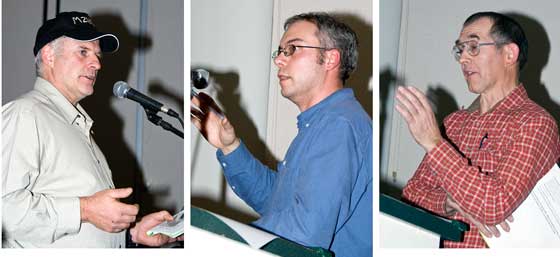
Pictured Above: PETER HARMS TROY HEGEL ADAM GRINDE
Photo by Whitehorse Star
Pictured Above: PETER HARMS TROY HEGEL ADAM GRINDE
Off-road vehicles were again in the centre of debate Monday evening over proposed restrictions to sheep hunting in three areas between Whitehorse and Kusawa Lake.
Off-road vehicles were again in the centre of debate Monday evening over proposed restrictions to sheep hunting in three areas between Whitehorse and Kusawa Lake.
Maybe the disappearance of rams on the west side of Fish Lake is not at all linked to hunting pressure, it was said during a public meeting hosted by the Yukon Fish and Wildlife Management Board.
Perhaps, suggested Adam Grinde, it's the abundance of ATVs and other vehicles out riding through the mountainous terrain that has sent the sheep in search of another range.
Grinde said when you go from a 1994 count of 40 rams in game management subzone 7-19 to zero in 2009, it's not an issue of hunting.
"That is an issue of disturbance,” the member of the Teslin Renewable Resource Council told the audience of 40 to 50 gathered for the board's annual Whitehorse meeting to review proposed changes to regulations under the Wildlife Act.
Several others questioned Environment Yukon's desire to implement a permit hunt for 7-19, which borders Fish Lake; 7-16, which surrounds the popular Mount Arkell sheep range; and 7-14, which runs along the north end of Kusawa Lake on the east side across from the campground.
In 7-19, rams have disappeared completely, reads the material submitted to support the department's request.
In the other two, the annual harvest is either at or slightly above the sustainable level.
It was suggested, however, that there was a lack of information with which to properly assess the department's proposal, and that maybe a more holistic approach to sheep management should be considered.
"It would be nice to know if a permit hunt system even works, or if we should be be talking about the wolf management plan even more,” said Wade Istchenko.
Tim Mervyn, president of the Yukon Outfitters Association, wanted to know if the department could describe what impact closing the three subzones and implementing permit hunts will have on other sheep hunting areas.
Inevitably, reducing pressure in one area increases pressure elsewhere, he said.
"I have no problem with permits,” said Don Toews, a retired biologist. "But I agree with the domino effect.
"I would like to see more of a strategic approach instead of coming back year after year and doing it piecemeal.”
Sheep biologist Troy Hegel was asked to provide additional harvest information to provide a clearer picture of hunting pressure in the three subzones, as well as provide an assessment of how well permit systems have worked in neighbouring subzones.
Peter Harms, an avid sheep hunter, repeated his thoughts of a couple of years ago during the debate over closing ATV access above the treeline on Pilot Mountain to protect what was said to be a population under extreme pressure.
There's no question the sophistication and power of today's off-road vehicles is adding to the number of sheep being hunted, Harms told the meeting.
As he did two years ago, Harms pointed out hunters can get from downtown Whitehorse to the top of Mount Arkell in 2 1/2 hours.
"We now have machines that dump you into the same country just as easy as choppers, and we are doing nothing,” Harms told the audience, which included several members of the management board.
Access, he insisted, is an issue for wildlife management.
In the matter of the Pilot Mountain debate, it was argued some hunters would not be able to access sheep country without the assistance of off-road vehicles.
In the case of Pilot Mountain, the management board accepted the request of the Ta'an Kwach'an Council and the Lake Laberge Renewable Resource Council for a two-year closure and a prohibition of ATVs above treeline.
Both proposals were based largely on a bank of scientific research into the Dall sheep population through the Miners Range, located immediately northwest of the Takhini Hot Springs Road.
Then-Environment minister Elaine Taylor rejected the board's recommendations for the closure and restricted ATV access.
Instead, she implemented her department's preference for a permit system and additional monitoring of ATV use.
The wildlife management board and Environment Yukon are planning to initiate a public review of the department's wolf management plan.
It was developed in the early 1990s as a springboard to the wolf-kill program in the Aishihik area.
The controversial aerial cull was used as a means of protecting declining caribou and moose populations.
In order to encourage thoughtful and responsible discussion, website comments will not be visible until a moderator approves them. Please add comments judiciously and refrain from maligning any individual or institution. Read about our user comment and privacy policies.
Your name and email address are required before your comment is posted. Otherwise, your comment will not be posted.
Comments (2)
Up 0 Down 0
TIRED on Nov 18, 2010 at 4:15 am
Why do we blame the ATV for everything
Up 0 Down 0
Mike Kohler on Nov 17, 2010 at 1:17 pm
Maybe;
perhaps;
suggested;
lack of information;
maybe a more holistic approach;
would be nice to know;
provide a clearer picture;
In other words the expert scientists are clueless! But let's do something!
The cream of the poetry of the evening must be these two slogans that sound more like they are coming out of the advertising department of an ATV company:
the sophistication and power of today's off-road vehicles;
machines that dump you into the same country just as easy as choppers;
Wow, I didn't know my ATV could fly. I'm disappointed, it never dumped me in pristine places either. But if I can figure it out how to get airborne, I gladly assist with my magic ATV when the next aerial wolf cull gets going. No, not on the ground!