Photo by Whitehorse Star
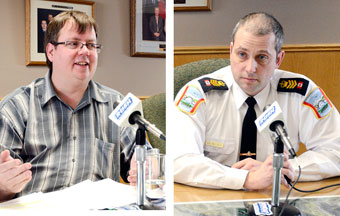
Chris May and Dave Pruden
Photo by Whitehorse Star
Chris May and Dave Pruden
Whitehorse could require a mandatory safety course for ATV operators, says the city's manager of bylaw.
Whitehorse could require a mandatory safety course for ATV operators, says the city's manager of bylaw.
Dave Pruden said just as the safety course is now mandatory under the new snowmobile bylaw, it would make sense to include the requirement in the all-terrain vehicle bylaw now under review.
Similarly, the city is proposing to make helmets mandatory for ATV users, he pointed out.
On Thursday, Pruden and Chris May, the spokesman for the ATV task force, released 24 recommendations the task force has come within its six months of work.
The release of the recommendations marks the beginning of an 18-day public consultation period, including an open house at the Canada Games Centre from 4 p.m. to 7 p.m on April 11, Pruden explained.
He said the intent is to have the first draft of the proposed bylaw before city council and out for a period of public review some time in late April or May.
The target is to have the new bylaw in place by early July, before summer holidays kick into full gear, Pruden said.
Missing the target of early July, he said, would delay the process because of the inability to conduct adequate public discussion while people are doing their travel and such.
Included in the recommendations from the task force is also a suggestion that the city encourage the Yukon government to make helmet use mandatory across the territory, just as it is in territorial regulations governing snowmobiles.
The task force is also recommending the city encourage the government to implement its own mandatory safety course for the use of off-road vehicles.
May explained the recommendations fall into the categories of safety, protection of the environment, trail conflict, trail development and nuisance activity.
Ultimately, he said, the goal is to have a network of multi-use trails connecting every neighbourhood of the city.
Finding a way to get out of Riverdale and up to Porter Creek might be a challenge, but that's the goal, he said.
Pruden said the motorized trail system for ATVs is likely to be the same network of trails for snowmachines, except for environmentally sensitive areas which are frozen and protected by snow in the winter but are susceptible in the summer.
"That would be easier,” he said. "There is less education we have to do when there is consistency. We have a lot of people with ATVs and snowmachines, and a lot own both.”
Both Pruden and May emphasized the effectiveness of the ATV bylaw will depend largely on a successful education campaign.
The task force, for instance, is recommending the campaign education be brought to the schools, summer camps, that it include pamphlets at the point of ATV sales, community meetings, courses, advertising and opportunities for dialogue between different groups.
Some of the other recommendations include:
• The task force and city work with neighbourhoods and trail users in the development of the trail network to ensure the environment is protected and sensitive areas are avoided;
• That a code of conduct and a model of trail etiquette be promoted, along the lines of the standards for the Trans-Canada Trail;
• That adequate signage be provided;
• That the trail network provide for all users: motorized, mixed and non-motorized;
• That the development of the trail network includes the direct involvement of neighbourhood associations;
• That different speed limits be established for trails, depending on their location;
• That the city provide adequate financial and human resources to continue development of the city's trail network.
The task force spokesman said the task force brought together a wide range of community organizations involving the full spectrum of interests.
May said just as his Off-Road Riders Association has a segment of the membership that is opposed to any regulations whatsoever, there are also Whitehorse residents who don't want any motorized vehicles on city trails, period.
The task force, he said, had to focus on the large majority of trail users – motorized and non-motorized – who agree reaching some sort of consensus on trail use is really the only solution.
Conflict between trail users is still very much a reality, May said.
The city has a long way to go to complete its trail network, he added. Just how long it will take will depend on what type of resources the city puts into it, said May.
The legislature's all-party committee on the safe use of off-road vehicles delivered its report to the house last March. Nothing has come of the initiative so far.
While the four committee members recommended the mandatory use of helmets while riding off-road vehicles on streets and roadways, they could not reach agreement on the use of helmets while riding off-road, according to the report.
In order to encourage thoughtful and responsible discussion, website comments will not be visible until a moderator approves them. Please add comments judiciously and refrain from maligning any individual or institution. Read about our user comment and privacy policies.
Your name and email address are required before your comment is posted. Otherwise, your comment will not be posted.
Be the first to comment