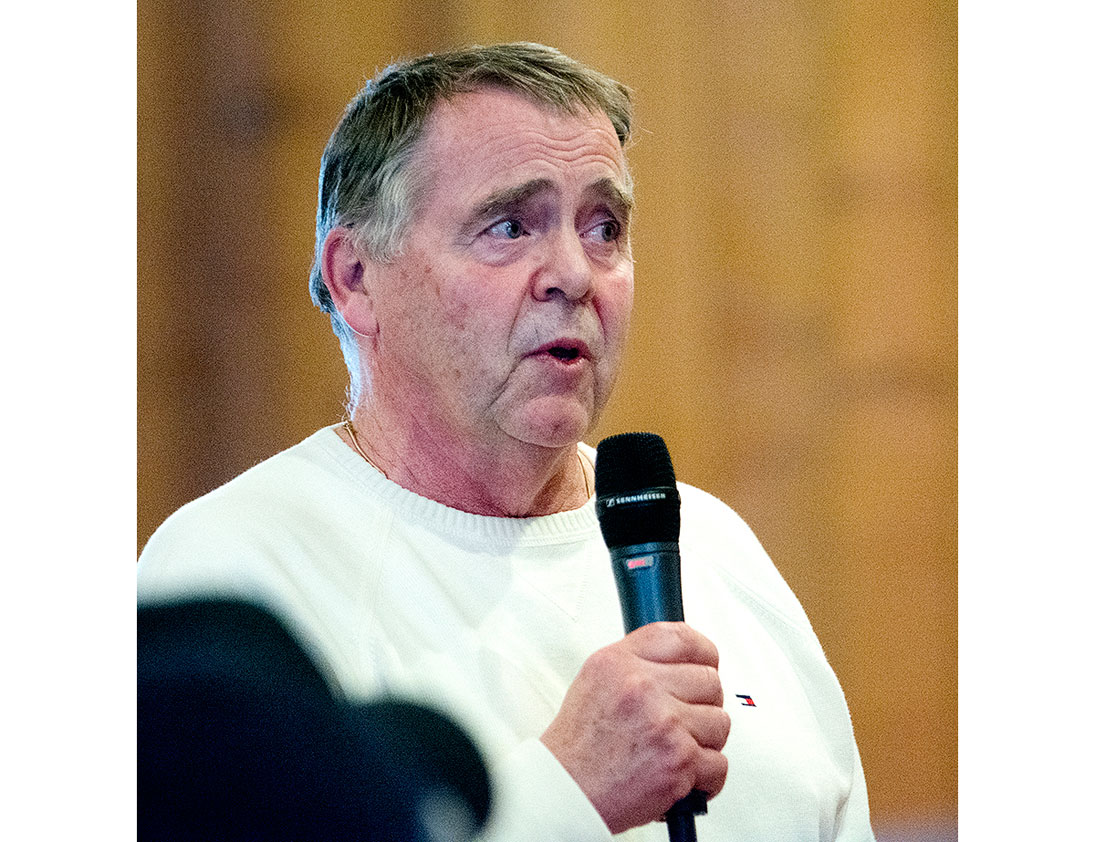
Photo by Whitehorse Star
Gord Zealand
Photo by Whitehorse Star
Gord Zealand
A request by the Yukon Fish and Game Association to participate in a lawsuit over the issuance of big game tags inside the Ross River area has been granted.
A request by the Yukon Fish and Game Association to participate in a lawsuit over the issuance of big game tags inside the Ross River area has been granted.
Justice Ron Veale of the Yukon Supreme Court announced his decision late this morning. It followed submissions Wednesday afternoon from the association and the Ross River Dena Council.
Veale cited the sworn statement provided to the court by Gord Zealand, the association’s executive director, outlining the group’s intimate involvement with the management of the territory’s wildlife since 1945.
“In my view, there are important issues of constitutional law in this case,” the judge said.
He said the association’s views may assist the court in determining the case.
Ross River filed the legal action last July.
The First Nation is seeking a court declaration that the Yukon government must consult the First Nation prior to issuing hunting licences and seals for hunting big game inside its traditional territory.
No date has been set for the trial.
Prior to the big game challenge, Ross River won a similar legal challenge when it insisted the government had a duty to consult prior to permitting the staking of mineral claims inside its traditional territory.
As a result of the decision by the Yukon Court of Appeal in December 2012, all staking in the Ross River area was subsequently frozen while the First Nation and the government negotiate an arrangement. They’re still in discussions.
The fish and game association filed an application to intervene in the case over the big game tags, arguing that its 800 members could be directly affected by the court’s decision.
Ross River, on the other hand, argued the association should not be allowed to participate because it does not a have direct interest in the matter. Nor has it provided the court with any information showing how it would be affected by the outcome, the First Nation argued.
Besides, the case revolves entirely around a point of law arising from the Court of Appeal decision in the case of the mineral claims, Ross River lawyer Stephen Walsh emphasized Wednesday.
The government did not take any position on the association’s application.
Veale explained Wednesday to the fish and game association’s executive director the courts have said that to gain intervener status, parties must meet one of two tests: a party must demonstrate it would be affected directly by the outcome of the case; or that the party is in a position to provide special insight to assist the court.
Veale told Zealand at the outset Wednesday he didn’t think the association is directly affected by Ross River’s legal challenge.
And this morning, the judge cited a 2012 B.C. Court of Appeal case in which a commercial fishing association sought but was denied intervener status in a case between a First Nation and the province.
The association was denied even though the court’s decision may have resulted in a lower allotment of fish for the commercial fishery, he pointed out.
But Veale did acknowledge the association’s insight may assist the court, given the organization’s long-standing involvement with the Yukon’s wildlife.
Zealand argued Wednesday his group’s membership is very much directly affected by the case.
“At the end of the day, we are a very interested party,” he said. “Other than the First Nation, I am not sure who else would be more directly affected other than us.”
Zealand suggested the challenge to issuing big game tags inside the Ross River area will affect the association because its members are among those who use big game tags to hunt inside the Ross River area.
He said he couldn’t imagine any more direct interest than that.
Walsh said if intervener status was granted, Ross River wanted the association’s participation restricted to a five-page written submission with no ability to make oral arguments at trial unless invited to do so by the court.
Nor should the association be permitted to duplicate any arguments put forward by the government, he said.
Veale agreed, and set down the conditions asked for by Ross River.
He also ordered the standard conditions attached to intervener status: the association will not be able to claim court costs, will not be liable for court costs and will not be able to appeal the decision of the court.
In a short preliminary matter before the hearing got underway in the intervener application, Yukon government lawyer Mark Radke raised the government’s concern with Ross River’s desire to jump straight to trial.
Walsh suggested to Veale there is no need to go through the process known as examination for discovery, a sometimes lengthy process where the parties exchange questions and answers about their positions on a case.
There’s no need to go through a lengthy pre-trial preparation process because the case of the hunting licences and big game tags boils down to a point of law, as determined by the Court of Appeal in the case of the mineral claims, Walsh argued.
Veale, however, said the parties will be sticking to the regular route for now and Walsh can speak further to his position on March 2, when the parties are already scheduled to meet with the judge for a case management conference.
In order to encourage thoughtful and responsible discussion, website comments will not be visible until a moderator approves them. Please add comments judiciously and refrain from maligning any individual or institution. Read about our user comment and privacy policies.
Your name and email address are required before your comment is posted. Otherwise, your comment will not be posted.
Comments (4)
Up 5 Down 24
mary laker on Feb 21, 2015 at 10:02 am
The Yukon Fish and Game Association believes in the right to shoot bears from the side of the road in the Yukon, no matter how many people they hurt and dissappoint with their actions. It's all about them, all the time. They are selfish and all elbows when it comes to what they want.
Keep this in mind when considering their 'rights'. They do not want anyone else to have rights that might interfere with their enjoyment of killing animals. If they had ever shown any interest in considering other people's points of view, I would have seen that they are reasonable, balanced people. That is not the case however. They are all about themselves and themselves only.
Up 36 Down 3
Again we have judges setting public policy on Feb 20, 2015 at 1:06 pm
This process has to be reviewed by constitutional lawyers that if any of this goes through the courts it is discriminating against non First Nation people. The judge should not even be hearing this case at all.
Up 33 Down 4
ProScience Greenie on Feb 19, 2015 at 6:46 pm
I don't get the decision. Just about every Yukoner that hunts might be 'affected directly by the outcome of the case'. It's an important court case, the more Yukon voices heard the better.
Up 11 Down 14
Mark Southerland on Feb 19, 2015 at 6:07 pm
"Veale told Zealand at the outset Wednesday he didn’t think the association is directly affected by Ross River’s legal challenge.
And this morning, the judge cited a 2012 B.C. Court of Appeal case in which a commercial fishing association sought but was denied intervener status in a case between a First Nation and the province.
The association was denied even though the court’s decision may have resulted in a lower allotment of fish for the commercial fishery, he pointed out."
This is a government to government issue and the YF&GA should not be involved period. Their perspective is not wanting any change in hunting opportunities. They have said they do not want to stop roadside bear hunting- not much can be positively said about the dogma if it's working, do not change it.