Photo by Vince Fedoroff
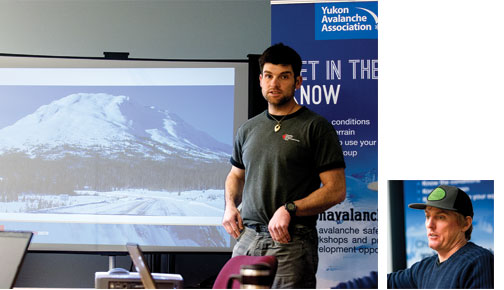
A CASCADE OF INFORMATION – Avalanche technician James Minifie makes a point during Monday afternoon's media briefing.
Photo by Vince Fedoroff
A CASCADE OF INFORMATION – Avalanche technician James Minifie makes a point during Monday afternoon's media briefing.
The avalanche hazard in the White Pass area and along the Annie Lake Road and Wheaton River Valley has been downgraded from considerable to moderate.
The avalanche hazard in the White Pass area and along the Annie Lake Road and Wheaton River Valley has been downgraded from considerable to moderate.
The Yukon Avalanche Association updated its online bulletin Monday, after issuing a special warning last Friday.
The Special Public Avalanche Warning is not issued lightly, avalanche forecaster Joe Lammers of the Canadian Avalanche Centre explained Monday during a briefing hosted by the local association.
Special warnings, said Lammers, are used sparingly to avoid watering down their importance when there is a real need to ensure the public is paying attention to the dangerous conditions in high country.
The danger rating heading into the past weekend was considerable in the alpine and moderate at the tree line, he explained.
Lammers said the warning was issued because of the danger rating for avalanche activity coupled with the anticipated weekend rush of snowmobilers, skiers and boarders headed into the mountains during the spring break.
A mid-February snowfall has created an unstable bed for subsequent snowfalls. Together, they are a concern across the White Pass and Wheaton River Valley region, Lammers and staff with the association explained.
The weak layer caused by the mid-February snowfall has resulted in an unstable snowpack with high consequences if it lets go, Lammers explained.
He said the existing situation is like having a big mattress of snow sitting on top of a table of marbles.
Avalanche technician James Minifie said the terrain throughout the region is complex, but very accessible.
"We have some really high-end snowmobilers and skiers in the Yukon, and they are riding in some places out there you would not believe,” he said.
Minifie is one of the association's three field staff who's in the White Pass mountains every day during the season. He assesses conditions, takes profiles of the snow and prepares three bulletins a week regarding the avalanche danger rating.
Lammers was up in the Yukon on one if his monthly visits from the Canadian Avalanche Centre in Revelstoke, B.C.
Not more than an hour after Monday's briefing, word came out of Revelstoke of another back-country enthusiast killed in an avalanche – the 14th this season.
Knowing avalanches and the conditions which make them so dangerous should be a priority for all back-country users, said Jeni Rudisill, the avalanche association's program manager.
Rudisill and the crew who put together the avalanche forecasts for the White Pass region hosted the briefing as part of their outreach to promote avalanche awareness.
Along with being educated about avalanches, back-country enthusiasts should be equipped with the proper avalanche gear, and should know how to use it, they emphasized.
"If your friend is buried, you don't want to be looking at it for the first time,” Lammers said about the gear everybody should be carrying.
There's a 90 per cent chance of survival if an individual is dug out within the first 15 minutes, it was explained during the briefing.
Chances drop off to between 40 and 50 per cent after 25 minutes. After 45 minutes, they're slim.
When it comes to avalanche rescue, whoever is on site is the rescue party, because there's no time to go and get help, the experts emphasized.
Lammers said at the very minimum, snowmobilers, skiers and boarders should have a backpack with a transceiver, an avalanche shovel and a collapsable probe that extends like a tent pole with a simple pull of the string.
The transceiver, Lammers explained, is set to send out signals, but when someone is buried, those left on the surface can switch their transceiver to a receiver to pick up and hone in on their buried buddy.
Even if you're riding your snowmachine, he said, the emergency equipment needs to stay on the rider in a backpack.
More and more back-country users are now including balloon packs in their personal safety equipment, Lammers said.
He said the bags help keep an individual buoyant or on top of the surface when caught in a slide.
But the most useful safety tool is knowledge, Lammers insisted.
If he had to pick between emergency equipment and an educated understanding about avalanches, he said, he'd pick his brain anytime.
Of all the avalanche accidents, 90 per cent are triggered by the back-country user, it was pointed out.
Lammers said having an educated understanding about avalanches, what conditions and weather patterns set up dangerous situations and what to look for is essential.
Knowing how to manage group participation in the back-country to minimize risk is important, and having the background on avalanches will help the user interpret the three weekly avalanche bulletins produced by the avalanche association, it was said.
Seeing tracks in the snow, they said, does not mean conditions are safe.
Minifie said over the years, it's been a pretty savvy group of back-county users in the Yukon.
The emerging trend these days, however, is seeing a greater mix of enthusiasts who are not so savvy nor familiar with the coastal mountain terrain.
Rudisill pointed out there are a handful of avalanche training instructors in the Yukon who offer courses regularly. She estimates more than 200 a year go through the course.
Level one takes about 2 1/2 days, most of which is in the field, she said.
Meanwhile, the Department of Highways and Public Works is keeping an eye on the South Klondike Highway.
"The indication is small avalanches are likely but they are expected to terminate above the highway,” department spokeswoman Brittanee Stewart said this morning.
"Large avalanches are possible, but they are also expected to terminate far above the highway.
"We did avalanche control last Thursday and we're planning to do more this week as long as the weather conditions stay favourable,” Stewart said.
In order to encourage thoughtful and responsible discussion, website comments will not be visible until a moderator approves them. Please add comments judiciously and refrain from maligning any individual or institution. Read about our user comment and privacy policies.
Your name and email address are required before your comment is posted. Otherwise, your comment will not be posted.
Be the first to comment