Apology 'a long time coming': grand chief
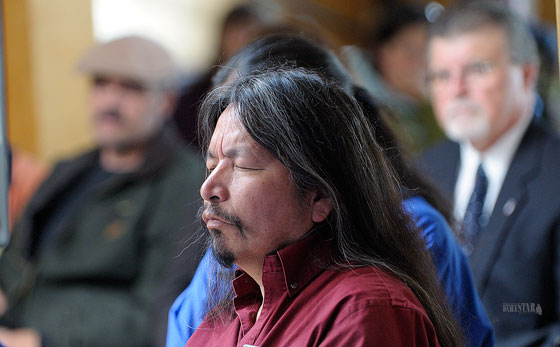
It was a sombre atmosphere at the Council of Yukon First Nations (CYFN) building Wednesday as people gathered to watch Prime Minister Stephen Harper apologize to former residential school students.
By Jason Unrau on June 12, 2008
It was a sombre atmosphere at the Council of Yukon First Nations (CYFN) building Wednesday as people gathered to watch Prime Minister Stephen Harper apologize to former residential school students.
Some bowed their heads and others held each other while the webcast from Parliament Hill in Ottawa was beamed into the CYFN cafeteria.
The picture quality may have been poor but Harper's words came in clear, as he called the government's policy of assimilation, which involved forcing aboriginal children into state-funded Christian schools, "a sad chapter in our history."
Then, the prime minister uttered words that so many have waited so long to hear.
"Today, we recognize this policy of assimilation was wrong, has caused great harm, and has no place in our country. The Government of Canada sincerely apologizes and asks for forgiveness of the aboriginal peoples of this country for failing them so profoundly."
Harper's apology was followed by similar sentiments from leaders of all opposition parties.
Following Bloc Quebecois Leader Gilles Duceppe's remarks, spoken entirely in French, in which he said it was his party that had been the first all along to demand the apology, the webcast was turned off, with attendees preferring to hear their own speak.
CYFN Grand Chief Andy Carvill was first, addressing those in the cafeteria, while back in Ottawa, Assembly of First Nations Grand Chief Phil Fontaine addressed Parliament and Canada.
Carvill called it "a bittersweet day" and "a long time coming."
"I'm hoping it's going to help some of the people who suffered those attrocities at mission schools," he added. "And I hope we can put some of those dark years behind us, that we can move forward."
The fact that apologies from all federal leaders contained French irked many aboriginal people in attendance, including Carvill.
"As we sat here and listened to some of them speaking in French, it's a sad moment for our people because we know (the government's) done what it could to take our languages away," he said.
Due to the government's policy of assimilation, most residential schools forbade speaking in one's native language while those caught were often severely beaten.
Carvill also took a swipe at Premier Dennis Fentie - who was in attendance - over his government's handling of the Child and Family Services Act.
The CYFN and Fentie had been at loggerheads over consultation on recent amendments to the act.
"Still, we have policies that allow workers into our homes to take our children away," said Carvill. "We have to make sure no more kids leave our communities."
After Carvill spoke, the floor was opened to those who wanted to share thoughts on their experiences with residential school.
It was an emotional afternoon. After Carvill, several other speakers took the floor, including some ex-residential school students, and spoke about the impacts of the former government policy.
While Harper's gesture is being hailed as an historic milestone, for many, the cash settlements - via common experience payments - and yesterday's apology have brought about painful memories that many would rather forget.
Kwanlin Dun Chief Mike Smith said the day marked a turning point and that it was crucial for aboriginal people to look ahead rather than dwell on the past.
"I really believe that as first nations of this country, this was long overdue," Smith of the apology.
"This is a really important event for us.... I really feel that we have to accept the apology, we have to forgive, we have to move on, we owe it to our children."
Norman Drynock, a social worker who has seen firsthand the fallout from residential school, spoke of the need to look at the big-picture impacts.
"My sister said, 'look, I did really well, residential school was good to me,' and I said, 'look at all the people, your family that's left, look at all the one's who've died," said Drynock.
"In my home, the only place that never had a coffin at one time or another, was the kitchen."
"Like Norman, I have mixed feelings about the apology too, like the (common experience) claims and all that, it makes us relive it all," said another gentleman.
Former CYFN Grand Chief Ed Schultz talked of the generational legacy of residential schools.
"Everyday, I see kids outside my shop who are killing themselves (through substance abuse)," said the local restaurateur.
"This has to stop, and we have to work hard at building our families again, not a western European family but a strong aboriginal family."
The importance of family weighed heavily at the gathering, many speaking about the impacts of residential school on parents then, and their own parenting skills.
One woman offered a tearful apology to her children she said suffered due to her neglect.
"Life was pretty rough for them because of where I came from, so right now I want to tell my children how sorry I am for all the hardships you've been through," she said, before being joined by three other women in a tearful embrace.
"I've apologized before, but I can never tell you how sorry I am."
Jessie Dawson punctuated the sentiment with a poignant question.
"What about our parents and our children? How can we help our children when we're trying to help ourselves?" she said. "My heart goes out to them all."
And one after another, people bravely stood to address the audience with words whose impact rippled through the room.
Among the crowd of almost 100 were leaders and representative from first nations communities, as well as the leaders from all of the Yukon's political parties.
"Individuals waited a long time for this day to arrive and are quite relieved that a shameful page in Canada's history has been turned," said Liberal Leader Arthur Mitchell.
"While the apology cannot undo the damage that was done ... it will hopefully allow many to continue on their healing path."
Fentie also offered his reflections in a statement released Wednesday.
"Prime Minister Stephen Harper's apology to former students of Indian residential schools is welcomed by the Government of Yukon," he said.
"The apology was made in the House of Commons today on behalf of the Government of Canada and all Canadians.
"The Yukon government encourages all Yukoners to acknowledge and remember this day. This apology marks a new era, one in which citizens and governments can start to build new relationships.
"The Yukon government supports the work of the Indian Residential Schools Truth and Reconciliation Commission and urges Yukoners who have been affected by the Indian residential schools' legacy to share their experiences with the commission."
Back on Parliament Hill in Ottawa, Yukon MP Larry Bagnell, a longtime proponent of aboriginal rights during and prior to his foray into federal politics, hailed the apology's significance.
"It was a day for the ages; this is really a historic day for Canada and the apology (and) along with the benefit payments, and the Truth and Reconciliation Commission, are forward-thinking agreements that Canada has with aboriginal people, that no other nation has," he said in an interview.
"(The apology) was sincere and meaningful, and it's a starting point. Without this type of reconciliation, you couldn't work together on some of these problems, and there's still healing that needs to be done."
Bagnell called the day "one of the most meaningful days I've had in Parliament."
"The gallery was filled with aboriginal people and they felt like it was their house yesterday."
Be the first to comment