Alternative energy is high on YEC's agenda
Nuclear power is out, but garbage from the Whitehorse landfill may be in.
By Chuck Tobin on January 26, 2011
Nuclear power is out, but garbage from the Whitehorse landfill may be in.
Yukon Energy is researching several alternative energy sources, members of the local business community and municipal council heard last week.
In his address to the monthly luncheon hosted by the Whitehorse Chamber of Commerce, Yukon Energy president David Morrison said the publicly owned utility hasn't given any consideration to nuclear generation, and won't be.
It is, however, actively pursuing other alternatives in light of the territory's growing demand for energy in both the domestic and industrial sectors, he said.
Morrison invited anyone with a plan to generate surplus energy that could be plugged into the grid to step up, even though the Yukon government has not yet completed its policy to guide independent power producers.
"We do not need to build it ourselves if somebody has a prospective project out there,” he said. "If independent power producers are out there and have projects, we are not fussy about where we get this.”
Morrison pointed out supplying energy needs in the Yukon presents a challenge because the power grid is isolated, eliminating any option to buy or sell surplus energy, unlike the situation in most provinces.
B.C., for instance, often sells power to California because of its large hydro capacity and can buy energy back if and when it needs it, Morrison told some 75 lunch guests.
He emphasized because of the isolation, the cost of future improvements to energy infrastructure must be paid for by Yukoners.
In keeping with Yukon Energy's 20-year resource plan produced in 2005 and scheduled to be updated this year, the utility, first and foremost, wants to squeeze more power out of the existing hydro system, he said.
Morrison said it's advancing research in the area of wind turbines and geothermal steam generation.
Natural gas, either from northern Yukon or the Alaska Highway pipeline, may be an option some day, he said, adding it's not as clean as hydro, but is better than burning diesel fuel to power the generators.
Coal is not an option, as it does not meet the territorial policies regarding the need to reduce CO2 emissions, he said.
As BC Hydro brings its main grid further north – to Bob Quinn Lake on the Stewart-Cassiar Highway by year's end – tying in the Yukon grid becomes more of an option, Morrison said.
But even the cost of bringing it down to Bob Quinn Lake – some 840 kilometres south of Whitehorse – is not in the millions, but rather in the billions, he said.
"The question is one, two, three....”
Morrison told his audience demand-side management – promoting greater energy efficiency and conservation – is an essential element in offsetting anticipated growth.
Without any new new industrial customers over the next six years, conservation, the new Mayo B project and this year's addition of a third turbine at the Aishihik hydro facility will handle the load for the most part, he indicated.
Bringing on the gold mine at Dublin Gulch near Mayo in 2014 as proposed, Morrison pointed out, and the need to add capacity through wind generation and increased storage of water in Atlin, Marsh and Aishihik lakes, becomes critical.
Otherwise, more expensive diesel generation would be required, with all its CO2 emissions, he said.
Morrison said adding the proposed Carmacks Copper Project to the mix, together with Victoria Gold, would leave no choice but to use diesels for the foreseeable future.
Never mind the Casino copper project, which alone would need 150 megawatts to operate, or more generation capacity than currently exists on both grids.
The completion of the transmission line between Carmacks and Stewart Crossing scheduled for this spring will be a huge benefit. That's because it ties the two grids together and allows for the transfer of surplus power between the two, he told his audience.
• Yukon Energy has so far spent $7.5 million researching proposals to increase storage in Atlin and Marsh lakes, as well as reversing the flow of the five Gladstone Lakes from Kluane Lake into the Aishihik watershed.
Completing the work, according to Morrison's numbers, would provide a significant amount of hydro capacity in the critical winter months.
But there is resistance, he noted. Yukon Energy's suggestion to raise the level of Atlin Lake in the summer has raised the ire of some.
"I know you've all be reading the people of Atlin are not very keen on this, but we are keen.”
Proceeding with all three methods of squeezing more energy out of the existing hydro system is cost effective, and is not technically difficult, he said.
Together, according to the numbers, they would add about 10 per cent capacity to the Whitehorse
Aishihik-Faro grid.
• Yukon Energy has so far spent $1.5 million researching geothermal options, looking for sources of underground hot water with a temperature high enough to drive steam turbines.
The potential is good, said Morrison, who indicated the corporation has partnered with the Champagne and Aishihik First Nations and the First Nation of Na-cho Nyak Dun on two specific proposals on their settlement lands.
He said the issue with geothermal is the location of the hot water resource, because too far off the grid means large transmission costs.
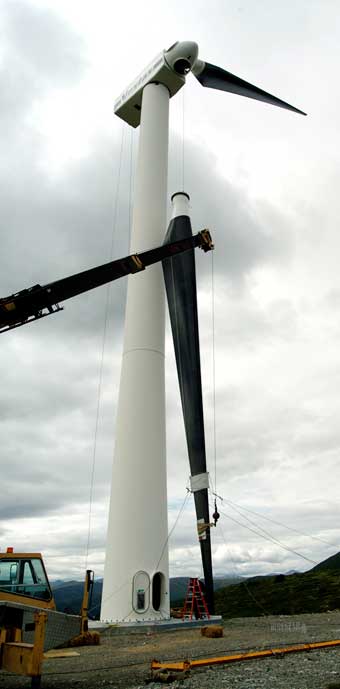
• Yukon Energy has so far spent $37,000 on wind research in its recent effort to explore alternatives, aside from what it's learned over the years from the two turbines on Haeckel Hill.
The most promising location for a wind farm at this point is Ferry Hill, Morrison said.
Ferry Hill overlooks Stewart Crossing and is right next to the two grids.
Morrison said there may be enough capacity there to generate up to 20 megawatts, or 25 per cent more than the maximum 15 megawatts that will be available from the Mayo hydro facility once Mayo B is complete.
The corporation is moving ahead with plans to install an advanced wind monitor on Ferry Hill, he said.
The drawback with wind, Morrison explained, is finding some way to compensate for its unreliable nature, though there may be an economical way to store the power.
In any case, when the wind is blowing and optimum output is achieved, the power would still reduce the amount of water needed to generate hydro, thus preserving it for when it's needed, Morrison explained.
He said research will also continue at Mount Sumanik, located west of Whitehorse.
• Yukon Energy has so far spent $466,000 studying a new hydro dam for the upper Pelly River, upriver of Ross River at the Hoole Canyon.
The Hoole project is identified in Yukon Energy's 20-year resource plan as one of three large hydro projects to be considered in the future.
According to the plan, it's generating capacity would be approximately 40 megawatts, the same as the Whitehorse Rapids Dam, at an estimated cost of about $412 million – in 2005 dollars.
There's lots of power there, Morrison said, but it's very costly.
• Yukon Energy has spent $236,000 examining whether it would be feasible to burn waste from the Whitehorse dump to create steam to power turbines.
An analysis should be available in early February, he said.
Morrison explained it's likely a system built on burning garbage would need to be supplemented with a supply of some sort of fuel wood, perhaps pellets.
To maximize efficiency, there would also be a need to find a use for the excess heat not captured in generation, he said.
Morrison told his audience that having the Minto Mine and now the Bellekeno Mine on the system are positive, not negatives. The Minto Mine's purchase of surplus power allowed Yukon Energy to drop its rate, he said.
More demand for electricity means growth and a healthy economy, though it also requires finding more power, he acknowledged.
"We are constantly reviewing what the load forecast looks like and how we might keep up with it,” Morrison said.
"I mean, we have to get more out of demand side management, more out of current capacity and we are still going to be short unless we find other solutions, which is was we are working on.”
Comments (1)
Up 0 Down 0
Susan Rogan on Jan 26, 2011 at 10:53 am
"Yukon Energy's suggestion to raise the level of Atlin Lake in the summer has raised the ire of some."
The actual plan is to keep Atlin Lake water levels at summertime highs well into the fall/winter season, then drop the level of the lake to produce energy.
The concerns of the people of Atlin include: weakening the ice, which people and animals currently cross in wintertime; changing the temperature of the lake, which will affect the fish; changing the pattern of the water depths along the shoreline, which can affect plants, animals and fish who count on certain levels to prepare for winter or to grow normally.
Those are the three I remember off the top of my head.
This is not a 'Green' energy plan.
"..the people of Atlin are not very keen on this, but we are keen." - David Morrison, Yukon Energy.
Suggesting what? That Yukon Energy does not intend to concern itself with the wishes and concerns of the people who live on the shore of the lake you want to flood each fall?
I guess Yukon Energy is bigger than Atlin, BC, and the people who live there. This is a reflection on all Yukoners, and we need to stand up and be heard on this one.
I truly hope Yukoners will support our neighbours in Atlin, BC. We should not shove this down their throats so we can have cheaper power. Oh, but it is supposedly 'Green', as per the big plan.
There's nothing green about this project except the money Yukoners may save, so let's look it in the eye and see whether it's worth knocking over our neighbours for this.
So far, I'm against the project, based on the material I have read from the society in Atlin that is trying to protect their lake, at their own expense of course, no $7.5 million fund for them, just volunteer citizens.