‘All you can hear is crying,' commission told
Imagine every single village across the North, every single one, from the Arctic southward – weeping.
By Chuck Tobin on January 16, 2013
Imagine every single village across the North, every single one, from the Arctic southward – weeping.
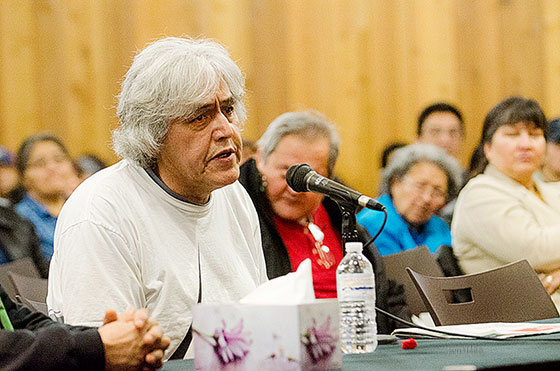
Because that's what happened, Edward Farr of Dawson City told the Truth and Reconciliation Commission of Canada on Tuesday morning at the Kwanlin Dun Cultural Centre.
"All you can hear is crying, and crying and crying,” he said during 30 minutes or so of testimony. "Because all the children were tooken.”
Farr said he remembers his years as a young boy running through the woods at the north end of Dawson City, playing with his friends, savouring the joys of youth.
"And then one day, everybody was tooken,” he told a room full of survivors of the Indian residential schools, counsellors and many who were there just to bear witness. "We just got tooken.
"For me, I ended up in a mission home. I walked in there, and that is all I remember until the doors opened and I walked out. I do not know how long it was; I just went blank.
"And many years ago, I asked a person who was there what happened and he said to me, ‘why do you want to remember something bad?'”
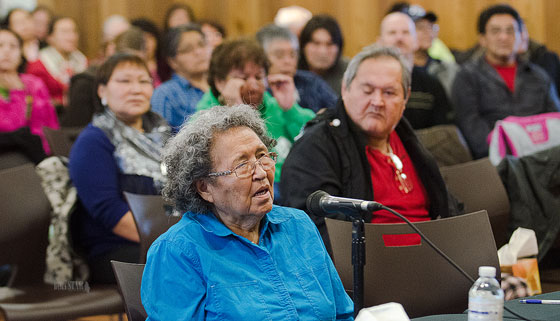
Selkirk First Nation elder Lizzie Hall told of literally been hustled from her family's bush tent by a police officer and a missionary at the age of 11, much to the objection of her grandfather.
Though she did provide a touch of humour, rare during the two days of stories filled with deep emotions.
Growing up on the trapline, she told the gathering, she only went into town once a year, in the spring when the winter's bounty of furs was sold.
She remembers looking down from the airplane while landing in Whitehorse, and seeing all the those green and blue lights lining the runway.
"I thought to myself, ‘how do those things grow out of the ground?'” she said, raising a chuckle from an otherwise sombre crowd.
Hall's story, however, was not funny.
She told of being sexually abused, but refused to express details.
Coming from a loving and spiritual family, Hall remembers being called a heathen and a pagan, a savage.
"I never heard those words before,” she said.
"There is lots of things that happened to me at school but today I do not want to talk about ... because it was awful. They treated me like I was nobody.”
The commission is in the final year of its mandate to report back to Parliament on the effects of more than a century of Indian residential schools in Canada, and recommend how to go forward. It produced an interim report last February.
But Farr said it will take more than the commission and its work to heal the legacy of the residential schools.
After the children were gone, he said, came the whiskey.
The sound of crying was replaced with the thunder of fighting through the villages.
Students returned home to find their parents drunk, something they'd never seen.
He said as the kids returned from what was often years of harsh living conditions, even they fought each other.
"And they were the same children we were playing with,” he told the gathering. "We did not know them, and they did not know us.”
It will take a substantial effort to bring back the aboriginal connection to the land and rekindle the spirit that was once so central to the culture of Canada's first people, said Farr.
"What is this reconciliation?” he asked. "I look at that and I think we have to reconcile with ourselves. I do not think an organization like this can give that spirit; you can't buy that spirit.”
Farr told of how he helped a woman carry her laundry down the street. She told him she felt that by accepting the financial compensation Ottawa was offering former students, she was somehow selling her soul.
"So we need to get that spirit from our people,” he said. "We need to keep the land for our people, not for the dollars.
"We need to get back onto the land to get that spirit to come into you.”
Farr said he would like to see all people of all colours help out, to support the Idle No More Movement, and help aboriginal people return to their traditional ways through peace and respect.
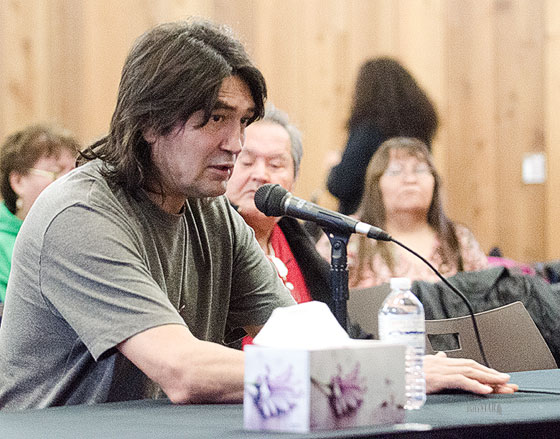
Like Farr, Richard Behn said the road of healing will be long, but not impossible.
Behn's experience with residential schools began at the age of five, when he was taken from his family in Fort Nelson, B.C. and sent to the residential school at Lower Post, just below the Yukon border. Two of his sisters were also there.
Behn learned the hand of discipline quickly, from the very first day as he followed his sisters out of the dining hall, rather than the 60 other boys who were strangers to him.
A supervisor grabbed him by the ear and tugged so hard, only his toes were touching the ground, he recalled.
There he was, being dragged back to the boys' side of the room, as students passed by. Crying, he said, was out of the question, lest he be the subject of ridicule later.
"She told me I was no longer allowed to talk to my sisters.”
Behn was sent to three residential schools, including Coudert Hall in Whitehorse.
Supervisors of Coudert Hall who committed sexual abuse have still not been held accountable for their crimes, he said.
Behn said when he was away at residential school, he should have been at home with his family, learning the ways of the Acho Dene.
"Because when they take all the children five to 15 out of a community, there is a huge impact,” he said. "You're taking the workforce out of the community.”
Behn said when he returned from residential school, he was different; he was no longer part of the community he left as a child.
The disconnect left by residential schools, he said, has created a moras of despair that still exists today.
Measuring the impact Indian residential schools have had on him is somewhat possible, to a degree, he said.
Behn said the impact it's had on his seven children is intangible.
"I know my children are not going to experience the things they could have experienced if I had not been involved in the residential school experience,” he said.
As the morning session of testimonies drew to a close, Vern Swan, the keeper of the fire, invited participants to the Feeding of the Fire Ceremony.
The ceremony traditionally takes place before the last meal of a gathering – which was to be Tuesday's lunch, he explained.
"The fire is a door for our ancestors to come back and check up on us, and also give us advice and understanding.”
Traditionally, he said, food is placed on a ceramic dish and set in the fire.
When the dish breaks, the ancestors have eaten and departed.
Chuck Hume, a Champagne and Aishihik First Nation elder, carried the plate of food to the sacred fire pit beside the Yukon River, and Swan placed the food on top of blazing logs.
As Swan sang the prayer song of courage, surrounded by many, the plate shattered.
See more coverage on the hearings, including the commission chair's closing address, in Thursday's Star.
Comments (5)
Up 0 Down 6
Show me the money on Jan 18, 2013 at 8:12 am
Hi Stan. Money has been paid already. How much more is required? This is a very sad story. I believe all these meetings do is hurt the ones who they are trying to help. Someday everyone will just have to move on and get on with their lives. And no, I'm not trying to disrespect anyone here, I'm just talking reality.
Up 3 Down 0
Wooly Socks on Jan 18, 2013 at 8:11 am
I am so grateful that everyone has a forum to communicate their experiences. It is such an important part of healing.
Up 2 Down 0
Hazel Skookum on Jan 17, 2013 at 8:32 am
I feel so much pain hearing the stories from residential school. It's something that is very hard to overcome.
To begin our stories is a beginning. It takes a great deal of courage to stand up and tell your story. Your story is part of history which needs to be told and understood by all.
We will overcome together through our mutual understanding of what we had gone through.
Thank you all who stood up and were heard.
Up 2 Down 0
Stan Rogers on Jan 16, 2013 at 9:01 am
The many churches and organizations who ran these hiddeous residential schools should apologize over and over again and contribute funding for class action suits and rehabilitation programs for the victims.
Up 1 Down 0
CV on Jan 16, 2013 at 8:55 am
I never really realized what the residential schools were like. Just reading this article makes me want to cry. I can't imagine my children being ripped from my arms like that. I am so sorry and I hope that the survivors can heal. Thank you for helping me understand just a little bit of what happened.