AFN's national chief visits housing site
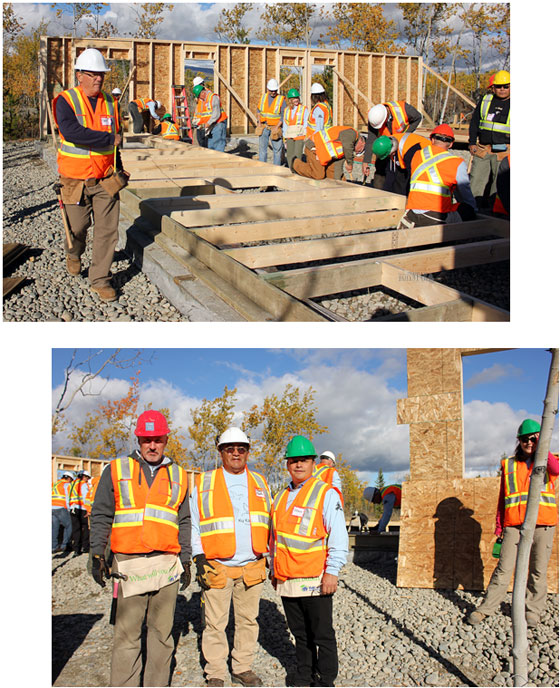
A historic Habitat for Humanity project is underway 50 kilometres west of Whitehorse – the first build on First Nations settlement land.
By Ainslie Cruickshank on September 17, 2012
A historic Habitat for Humanity project is underway 50 kilometres west of Whitehorse – the first build on First Nations settlement land.
"There are four million Canadians living in either unsafe or overcrowded or unaffordable housing, and we know those conditions are even more severe within aboriginal communities,” Stewart Hardacre, the president of Habitat for Humanity Canada, said in an interview Friday from the Takhini River subdivision.
"It was important to us to have an impact and make a contribution, and working with the aboriginal communities, we're finding ways to do just that.
"This first one on settlement land reflects that it can be done, and it's really just a matter of having that commitment.”
Shawn Atleo, the national chief of the Assembly of First Nations, noted that Habitat is also in talks for a first build on reserve land.
"Those two concepts themselves speak to an important moment in our history of settlement of the land question,” he said in an interview Friday at the Takhini River community hall.
"It's about First Nations having the rights to their land recognized and moving out from the deep dark shadow of the colonial past, which includes the Indian Act.”
The Champagne-Aishihik project is possible through Habitat's Aboriginal Housing Initiative, which was piloted in 2007.
In December 2011, the program was formalized with a signed agreement between Habitat and the Assembly of First Nations.
A month later, Terry Holway, the housing director for Champagne-Aishihik, jumped on the opportunity presented by the newly minted agreement.
By April, he had secured an agreement with Habitat for Humanity Yukon to build a triplex in one of the First Nations' four communities.
This is just the first of many houses Holway hopes will be built through the partnership with Habitat Yukon.
And "it could be a real model for all the other First Nations in Canada to help them build on settlement lands or reserve lands,” he said.
The process wasn't without hiccups, though.
Home ownership is firmly entrenched in Habitat's programs, but there are regulations and policies governing First Nations land that make it more complicated than builds on non-First Nations land.
Chief James Allen, of Champagne-Aishihik, said work is underway with the Yukon Housing Corp. to remove barriers the First Nations faced in trying to bring this project about.
The families selected for the Takhini River triplex will own the homes. The land will continue to be owned by the Champagne Ashihik First Nations.
While Allen agrees a key benefit of this first project is the door it opens for other First Nations to pursue similar partnerships, he noted the specific benefits for his community.
The most apparent of those is safe and affordable housing for some of the communities' most vulnerable families.
But Allen sees broader positives as well.
"The project itself, it will bring back the traditional value of our people who use to help each other to survive,” he said.
"That co-operation, helping each other in the community, is a value that has been eroded over the years, and I think it will bring back that value.”
Allen said he also believes the project, along with other economic development initiatives the First Nations are undertaking, will help rebuild the self-reliance of his communities.
Habitat for Humanity has set a goal of helping 100 aboriginal families secure home ownership over the next five years, Atleo said.
"That might seem small in relation to the 85,000 units that are required, but this is really about a spark,” Atleo said.
He's hoping this program will inspire others to undertake innovative initiatives as well.
"There are other major philanthropic and non-government organizations that are working elsewhere around the world,” he said.
"I hope many of them will consider taking Habitat for Humanity's lead and be inspired to work with First Nations at home.
"There's no easy way forward” and "no magic silver bullet,” Atleo said. It's going to take a mix of creative solutions to solve the crises facing many aboriginal communities across the country.
Increased funding, though, is desperately needed, he said.
"First Nations have been under a mandatory two per cent funding cap since 1996. There have been no increases for First Nations to support them in their housing, in their education, in their health.
"This is something that no other level of government has had to face. Provincial and territorial health transfers, for example, have been at a six per cent escalator annually,” Atleo said.
"First Nations do not have that, so chiefs very often are asking themselves with their transfer dollars, ‘what's my choice today; am I turning on the lights? Am I providing clean drinking water? Am I opening a school?”
Those aren't choices any government should have to make, he asserted.
Atleo and Chief Allen maintain that economic development is increasingly important to achieving healthy, sustainable communities. Settlement agreements, Atleo said, provide more opportunities for creating own-source revenues.
While funding is critical to developing education and health programs within communities, there are other needs.
Atleo and Allen agree healing must become a priority.
"Healing from the deep pain and suffering of decades of residential school policies, the physical and sexual abuse that happened in those schools and the intergenerational challenges that it created within families,” Atleo said.
"This is something that Canadians can absolutely walk hand-in-hand with First Nations.
"While the average Canadian didn't open that school, they didn't bring down the abuse themselves on those children in those schools, we can have a shared sense of citizenry when a neighbour is hurting, when a neighbour has been put down and oppressed, irrespective of what caused it.
"It's not about blaming; this is now about finding solutions for the future.
"That's what today helps symbolize and signify, that we can all share in the responsibility and all share in contributing to make the world a better place around us....”
Hardacre agrees Habitat's program can only be one of many solutions to the housing crises facing Canadians and aboriginal communities in particular, and the organization has called for a national housing strategy.
He was clear that a national strategy does not only translate into government funding, but also policy changes that better enable organizations like Habitat and the Champagne and Ashihik to find solutions.
It's also about recognizing the importance of adequate housing to the health of families and the health and overall well-being of communities.
"I really look at housing as a threshold issue. Without proper housing, the other things that we want for ourselves, want for our children, are so much more difficult to try and achieve.”
The Champagne Aishihik Habitat build is planned to be completed by the fall.
The triplex will have high-energy efficiency, with four-pane windows and double-door Arctic entrances.
It will also be outfitted with solar panels which will reduce the utility costs for the home owner.
Habitat for Humanity is in talks with other aboriginal communities across the country and has signed an agreement for eight units with the Tsawwassen, B.C. First Nation.
Talks are also underway with a Metis organization in Edmonton.
Be the first to comment