Abattoir strongly needed, advocate says
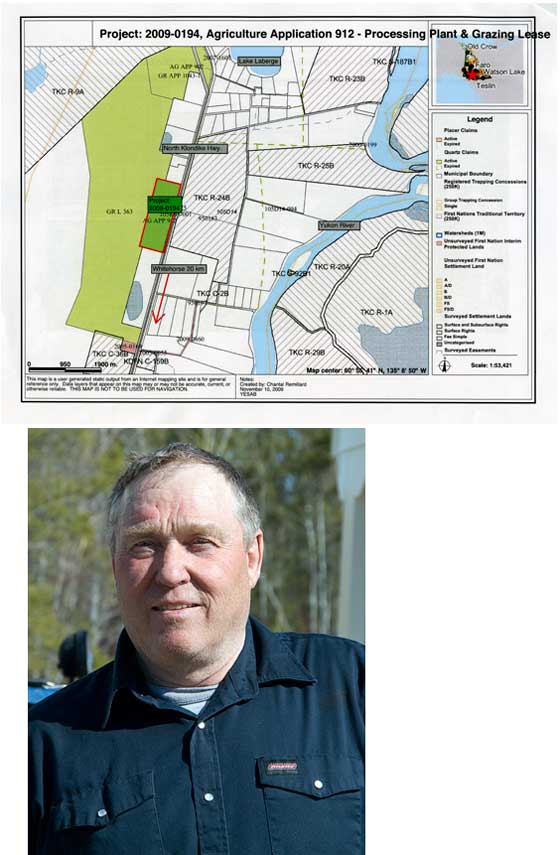
The Yukon Agriculture Association has begun its push for a permanent slaughterhouse and meat processing facility off the Mayo Road north of Whitehorse.
By Chuck Tobin on December 23, 2009
The Yukon Agriculture Association has begun its push for a permanent slaughterhouse and meat processing facility off the Mayo Road north of Whitehorse.
The association initiated the environmental and socio-economic review last month. The Yukon Environmental Socioeconomic Assessment Board (YESAB) issued a decision Monday to extend the period for public input to Jan. 15.
There have already been several concerns filed by the Ta'an Kwach'an Council, the Yukon Conservation Society and the neighbour to the north of the 65-hectare Yukon Government property. It's located on the west side of the North Klondike Highway, immediately north of the former rodeo grounds.
Association president Mike Blumenschein told the Star Tuesday the facility is required to stimulate growth in the territory's agriculture industry and raise the production of locally grown food.
There have been a couple of attempts to float a permanent slaughterhouse facility in the Whitehorse area, going as far back as 1988 and as recently as five years ago.
Last spring, the agricultural association, in partnership with the Yukon government, renewed the investigation of a permanent facility.
Currently, according to documents, about one per cent of all food products consumed in the Yukon is home-grown.
A modest forecast contained in the association's material indicate a permanent abattoir and processing plant could raise the number of cows slaughtered locally to 300 or more annually, capturing up to seven per cent of the retail beef market.
It could stimulate the production of up to 120,000 chickens and turkeys, capturing 25 per cent of the white meat retail sales, says the association's material filed with the YESAB.
Blumenschein said commercial growth of the local industry is dependent on a permanent facility.
"We hear that from so many people out there who are doing chickens and turkeys,” he said. "‘We do not mind raising them, but we do not want to kill them.'
"And the guys that are raising beef say the same thing: ‘We do not mind raising them, but we just don't have the time and are not interested in killing them.”
This past year, for instance, the four-year-old mobile abattoir that processes meat to commercially acceptable standards butchered 28 cows, up from 18 last year.
Blumschein said if a permanent facility is built, he wouldn't expect local farmers to be knocking down the door in the first year.
Nobody is going to stick their necks out with additional investment to raise more animals until they see a credible, operational facility able to handle and process their meat to industry standards, he said.
But once the facility is up and running, Blumenschein expects that in 10 years or fewer, Yukon farmers could be processing 300 cows a year or more, 120,000 birds and 1,300 hogs. Complementing that would be a number of other animals, including sheep, goats, and game farmed elk and bison.
"I really believe that,” said the hay farmer. "We feel this is a project that is needed to advance agriculture in the Yukon – all aspects of it.”
Part of the proposal, he said, envisions a community kitchen completed to commercial standards where local producers could prepare jams and other preservatives.
The facility, he said, would be governed under the strict regulations of the commercial food industry.
The 65-hectare parcel would not be used as a feed lot for where animals are kept for extended periods until they're slaughtered, but rather would be a facility where animals may be held for a day or two before the handled, he explained.
Blumenschein said the association will have no choice to address the many issues that come along, though he's convinced it can do so, given the technology available to the industry today.
Though both the Yukon Conservation Society and the Ta'an Kwach'an Council acknowledge the effort to increase the local production of food, their concerns are many.
In addition to the Ta'ans' belief that a slaughterhouse next-door would undermine future plans for its large block of rural land directly across from the
highway, the Lake Laberge first nation has raised several other issues in its submission to the YESAB.
It's not convinced, for instance, the abattoir could properly deal with the vast amount of waste product from slaughtered animals – up to 227,000 kilograms annually if the facility reaches its desired capacity – or the large volumes of waste water that would be generated.
"The waste management strategy described in the project proposal is vague ....” says the submission from Ta'an lands department.
The first nation points out the association suggests a portion of the waste from animal carcasses could be used to supply local trappers and mushers with dog food, while some waste may have to be composted or buried on-site.
The project proposal, however, does not address how much could be diverted through use as dog food, or how much would have to be buried or composted on-site, the Ta'an point out.
"It is recommended that a fully developed waste management plan be submitted before animal wastes could be considered for onsite disposal,” reads the submission from the first nation.
"Even if all the offal waste is brought to the landfill for disposal, information is required on how it will be stored on-site before transit.”
The first nation is concerned the presence of more livestock in the area would only worsen the existing problem of wolves being enticed by animals not properly penned on area farms, leading to the wolves paying the price after being declared nuisance animals.
There are concerns with the control over the spread of disease, particularly if sheep and goats are kept at the facility prior to slaughter; and the potential for escapement if elk and bison are boarded there for any time at all, the Ta'an point out.
Both the first nation and the conservation society have raised the issue of the proposed use of a septic field to manage waste water.
From the first nation's point of view, the high content of blood in the water would prevent proper treatment because there would be insufficient oxygen to break down the bacteria in the blood.
"It is therefore recommended that liquid waste be kept in a storage tank and transported off-site,” reads the Ta'an submission.
The conservation society also questions whether a septic field system could properly treat and handle the volumes of waster water contemplated.
It notes there is evidence that part of the property has a history of flooding in the spring, which could cause severe issues for septic systems.
The society also questions the possibility of contact between poultry temporarily penned at the facility and waterfowl that use a wetland on the property, causing a concern with the transmission of disease.
There is not enough information provided about the association's proposal to ship special waste south to B.C. for disposal regarding the economics or the willingness of the province to approve such a procedure, the society says.
Odor from waste or manure, it says, could be an issue.
"YCS supports the idea of increasing local food production, both in the interests of reducing the Yukon's carbon footprint, and supplying healthy food to Yukon people,” says the society's submission to the YESAB.
"However, it is critical to ensure that food production does not create environmental or socio-economic impacts.”
The society and the Yukon government's environmental protection branch both requested the YESAB provide an extension to the time permitted for public comment, given the project review is coming in the middle of the holiday season.
The association proposes a building that is 3,000 square feet, with two distinct areas and two separate loading docks for the mobile abattoir to back into – one area to process red meat, the other for white meat.
Only domestic animals would be temporarily penned or slaughtered at the facility, according to the association's submissions to the Whitehorse assessment office.
Game farmed animals like elk and bison would be slaughtered at the farm as they are now, and transported to the abattoir for processing.
The red meat section, for instance, would have an area to kill and hang the beef while they bleed out.
The animals would be moved along an overhead rail system into the mobile abattoir to be butchered into quarters and such.
The larger pieces of meat would be moved back to the main floor to hang in a cooling area before it's processed further, with the finished product available to local retailers or temporarily stored in large freezers that are part of project proposal.
The proposal, Blumenschein insisted, is economically sound.
"I think there is enough people out there who support locally grown food even if it is a little more expensive,” he said. "As far as the community is concerned, it just can't do anything but make the community better ... progress, it's called.”
Altogether, Blumenschein estimates the total project cost based on estimates from a similar exercise five years ago, would be in the neighbourhood of $2.5 million.
The association pursuing a long-term or permanent lease of the property owned by the Yukon government. The annual operation and maintenance costs have not yet been nailed down.
He said there is government funding available through a joint Yukon-federal agricultural policy to promote an increase in local food production.
In the association's view, it would be a facility which could be easily put to sleep for weeks or months when not required, then fired up in periods of peak demand throughout the year, Blumenschein explained.
Ideally, he said, the association would prefer to lease out the facility to a qualified operator, though it would remain under the control of the agricultural association.
Blumenschein said this is not an exercise to test the waters. The association is committed to seeing its proposal for a permanent abattoir and processing facility through to a final decision, whether it's yes or no, he said.
On the heels of the YESAB process, work will begin to design the facility.
It's not unrealistic to have an operational facility two years from now if all goes well, Blumenschein said.
Be the first to comment