‘This was a difficult decision to make'
The Yukon government has asked the Supreme Court of Canada for permission to appeal December's Yukon Court of Appeal decision regarding the staking of mineral claims.
By Chuck Tobin on February 25, 2013
The Yukon government has asked the Supreme Court of Canada for permission to appeal December's Yukon Court of Appeal decision regarding the staking of mineral claims.
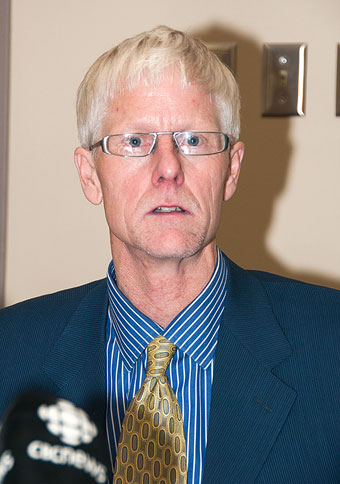
Tom Ullyett, an assistant deputy minister of Justice, explained at a news briefing this morning he estimates it will take about six months for a decision on whether the highest court will hear the appeal.
Ullyett said the Supreme Court of Canada only hears about 10 per cent of the cases of parties seeking permission for an appeal to be heard.
The cases, he said, must be of significant public interest and of national importance.
If the highest court agrees to hear the appeal, it could anywhere from 18 months to two years before there's a decision, said the government lawyer.
Ullyett said the Yukon government is seeking clarity on its duty to consult when it allows mineral claims to be recorded on lands where there is an assertion of aboriginal rights.
The three judges of the Yukon Court of Appeal ruled last Dec. 27 that the Yukon government does have a duty to consult the Kaska of the Ross River Dena Council before claims are recorded in their traditional territory.
The three judges also ruled a further duty to consult exists before any work of any sort is allowed to proceed on a mineral claim.
The mining industry, however, has indicated that consulting a First Nation prior to recording a mineral claims is unworkable.
In submissions at the original trial, the Yukon Chamber of Mines said the industry requires confidentiality when it comes to staking claims.
Requiring consultation prior to staking claims would remove that confidentiality, the chamber argued.
Premier Darrell Pasloski said in an interview late this morning the case is of national importance because most provinces and territories have some sort of free-entry staking system similar to the Yukon's for recording mineral claims.
"I can tell you this was a difficult decision to make,” Pasloski said of moving forward with an application to have the matter heard by the Supreme Court of Canada.
The government, said Pasloski, agrees there is a duty to consult before any work is undertaken on a mineral claim.
What the government needs clarified by the high court is how it goes about fulfilling the duty to consult when it comes to recording mineral claims, he said.
"It is a very complicated issue but this question really has not been asked,” the premier said.
"It is about seeking clarity and certainty for everybody, for the First Nations, for industry and for the Yukon government.”
The premier said if the highest court rejects the application, he is confident the Yukon would be able to sort out the issue before Dec. 27.
Stephen Walsh, the lawyer for Ross River, said this morning he is not surprised the Yukon is seeking permission to appeal.
He said he could not comment further because he hadn't had time to read the government's submission or talk to his client.
In an interview in late December, Walsh described the Court of Appeal decision as quite significant.
Under the Quartz Mining Act, individuals have the right to have their claims recorded without prior notification to anybody.
They also have the right to conduct some work on their claims, known as class one activity, without any need to secure any permits.
Class one work, for instance, includes clearing and line-cutting, digging holes and the use of up to a 1,000 pounds of explosives in a month.
Ross River sued the Yukon government in 2010. It argued that recording claims prior to consulting the First Nation failed to meet the duty to consult as defined out in other cases by the Supreme Court of Canada.
Yukon Supreme Court Justice Ron Veale ruled in November 2011 that there was a duty to consult.
But that duty could be fulfilled by notifying the First Nation that a mineral claim had been recorded, after it had been recorded, the judge ruled.
The Court of Appeal overturned Veale's decision. The three judges of the appeal court found the duty exists prior to the claim being recorded.
The Court of Appeal suspended its decision for a year, providing the Yukon government until next Dec. 27 to come into compliance with the decision.
Ullyett said if the application for leave to appeal is accepted by the Supreme Court of Canada, the government would apply for an extension on the Court of Appeal's one-year suspension.
If the Yukon is granted the opportunity to argue the appeal, it's difficult to say if other territories or provinces would ask for permission to make submissions, he said.
Like the premier, Ullyett said the case has national importance because many of the other jurisdictions have some sort of free entry system for staking mineral claims.
For example, when the Little-Salmon Carmacks First Nation used the duty to consult argument when the Yukon government to issue an agricultural property, the matter ended up before the Supreme Court of Canada.
The federal government sought and received permission to be a party to the proceedings.
So did Quebec and Newfoundland and Labrador, and eight other aboriginal organizations.
When the Court of Appeal decision came down after Christmas, the Yukon Chamber of Mines responded swiftly.
It indicated it would be working with and encouraging the Yukon government to take the matter to the Supreme Court of Canada.
Comments (2)
Up 1 Down 0
sam hollway on Feb 27, 2013 at 5:16 am
What a insincere waste of taxpayer money.
Premier Darrell Pasloski should initiate a sincere program that registers claims and outlines staking opportunities while working with first nations- ie committing to consult, exchange information and working with rather than against First Nations. First Nation government do not have the staff or funding to keep up with the mining exploration initiates in their respective areas.
The Auditor General should review the relationship between the Pasloski government and the First Nations. The Auditor General should also review the manner in which political conbtributions are made in the Yukon. We come across like a developing country- contribute to YP and when elected they will protect and further your interests over people who cast ballots. Its so backwards, it insincere, its an embarassment.
We could do so much better if the government chose to represent people and work with FN's.
Up 0 Down 0
Dan Davidson on Feb 26, 2013 at 8:47 am
Really? YTG wants to know what "to consult" means. I guess I shouldn't be that surprised.