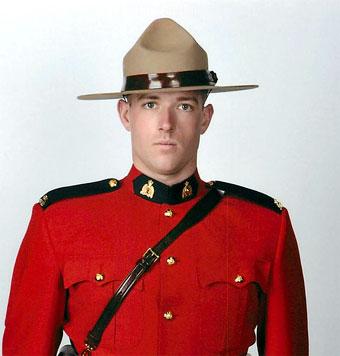
Photo by Whitehorse Star
Const. Michael Potvin
Photo by Whitehorse Star
Const. Michael Potvin
The failed motor on the boat which capsized, killing a Mayo RCMP officer, had a blockage in the fuel system — something that would best be corrected through scheduled service and repair, independent reports into the officer's death say.
The failed motor on the boat which capsized, killing a Mayo RCMP officer, had a blockage in the fuel system — something that would best be corrected through scheduled service and repair, independent reports into the officer's death say.
The Yukon RCMP have released some of the findings from investigations into the death of Const. Michael Potvin, who drowned on July 13, 2010, when his boat capsized on the Stewart River.
Potvin and another officer were performing maintenance on the boat.
The other officer stayed with the vessel and was later rescued by witnesses.
Potvin's body was not recovered from the river until a few weeks later.
Since that time, Human Resources and Skills Development Canada (HRSDC), Transport Canada, and the Transportation Safety Board have conducted independent investigations.
In a lengthy press release issued this morning, the RCMP detailed some of the findings of the reports and steps the police have taken following Potvin's death.
Testing and expert examination determined that several modifications had been made to the vessel over the years.
These, combined with environmental and mechanical factors, resulted in water coming over the transom, which made the vessel unstable in the water, the release says.
"Investigations identified a blockage in the fuel system as the cause for the motor failure. It was determined that it was unlikely that the blockage would have been diagnosed in the field, but would best be corrected through scheduled service and repair.”
The release comes nearly two weeks after the federal government was in court seeking to limit the scope of a public coroner's inquest into Potvin's death.
Lawyers argued that a Yukon coroner could not delve too far into the management or policies of the RCMP, claiming that is a federal matter.
The boat the 26-year-old Mountie was in, built in the mid-1980s, was removed from service immediately following the drowning, and the use of other vessels by the same manufacturer was suspended, the release says.
The hearing heard the vessels were built to RCMP specifications. In the end, six were removed from the water.
"New watercraft now meet specifications which have been developed to better reflect the type of activities police perform on rivers and lakes in the territory.”
Potvin and his partner made pre-voyage preparations which included gathering or acquiring the required safety equipment, the police say.
"The keeping of records reflecting pre-voyage planning, safety briefings and vessel maintenance were the subject of recommendations. Administrative processes have been developed to maintain and review records.”
Nationally, the RCMP now require annual inspections and reporting on vessel condition and equipment prior to using the equipment as well as monthly inspections, the release says.
There is no mention as to what the maintenance requirements were at the time of Potvin's death.
Calls to the RCMP were not returned in time for today's press deadline.
"The RCMP has implemented enhanced oversight and pre-approval for modifications to vessels to meet required standards for safe operation,” the release says.
Detachment water transport co-ordinators have been trained and receive updated information to promote safety.
"Detachment commanders are responsible for ensuring that vessel logbooks are completed and that watercraft are inspected and maintained.”
Senior supervisors also now have the responsibility to conduct random spot checks of water transport operations and policy compliance, including the wearing of personal floatation devices (PFDs).
PFDs were in Potvin's boat at the time of its capsizing, as required by already-existing RCMP policy.
Both Potvin and his partner had been wearing the equipment earlier in the excursion but neither had them on at the time of the incident, police say.
At the time of his drowning, the young officer, who was in his first year of service with the RCMP, was wearing soft body armour and a duty belt which included a firearm, baton and handcuffs.
Following Potvin's death, the PFDs used by the RCMP across Canada have been tested to confirm that they do provide sufficient buoyancy to support a fully-equipped RCMP member in the water, police say.
A series of emergency procedures has also been put in place, including the completion of a safety briefing, reviewing the operator checklist prior to each voyage and practising emergency drills have been implemented.
The independent investigations determined that the RCMP member who was operating the vessel had the certifications and training required to do so.
"The members were not, however, sufficiently familiar with the vessel or the specific waterway on which they were testing the watercraft prior to putting it into service for the season,” the release said.
A new division policy now requires that all operators be proficient and current on their detachment's vessel.
Operators who are new to the division or to the detachment vessel or who are not current, must undergo a proficiency test prior to operating it, police say.
Detachment commanders in the Yukon are also now required to seek local information about environmental and geological conditions of their region – including lakes and rivers. That information is provided to detachment personnel in writing.
"The lessons learned from this tragedy may also serve to inform and benefit the public and result in greater water safety practices by all Yukon residents,” police say in the release.
There is still no word on whether the scope of the upcoming inquest will in fact be limited.
At the time of the hearing, Judge Karen Ruddy —who will be acting as the coroner in this case — told lawyers not to expect her response until the end of June.
In order to encourage thoughtful and responsible discussion, website comments will not be visible until a moderator approves them. Please add comments judiciously and refrain from maligning any individual or institution. Read about our user comment and privacy policies.
Your name and email address are required before your comment is posted. Otherwise, your comment will not be posted.
Comments (4)
Up 0 Down 0
Jackie Ward on Jun 2, 2012 at 7:30 am
No vest? Wearing all his gear? And a blocked fuel line is to blame? There's not much else to this story. As sad as this story is the only one to blame is the officer himself. I have no disrespect towards him or his family. But just going off what the facts are.
Up 0 Down 0
Jaymanc on May 31, 2012 at 9:19 pm
UMMM, if the boat capsized, then the engine would fill up the lines with what ever is in the water, so saying that its because of clogged fuel lines, would have to have checked this before the boat was even on the water to say for sure. Saying that its clogged before after its been capsized is a poor choice and probably not all that true but maybe a sad attempt at a guess too. Don't believe me try it out. To sad.
Up 0 Down 0
flyingfur on May 30, 2012 at 1:04 am
This does not need to be complicated. Preventive maintenance would have solved the mechanical problem, but if somebody thinks that solving the mechanical problem that they will also solve the safety problem they are mistaken. There are multiple ways in which a vessel can end up "konking out" and maintenance will not solve all of these; they could have hit a rock later and knocked off a prop. Point is that weight shifted in the boat, water started to come in over the transom which negatively impacted the stability of the vessel and over it went. The constable was not wearing a PFD or lifejacket and to compound this problem was wearing body armour and duty/gun belt. With the current and the cold water there was little if any chance of making it to shore. Once your feet leave land wear your pfd or lifejacket - period. A very sad story.
Up 0 Down 0
Tim A on May 29, 2012 at 9:35 pm
Are you kidding me? Sounds like this is being blamed on vessel modification and poor maintenance instead of what it really is….carelessness (NOT WEARING A PFD). This very sad situation is totally as a result of making the poor decision to take off a (life saving) floatation device.