Serious housing problems persist, coalition says
The Yukon Anti-Poverty Coalition released the first of three progress reports on its housing action plan Monday.
By Vince Fedoroff on May 29, 2012
The Yukon Anti-Poverty Coalition released the first of three progress reports on its housing action plan Monday.
Focusing on emergency shelters and transitional housing, the first report shows some small steps have been taken, but much more still needs to be done to meet the goals of the coalition's housing action plan developed last year.
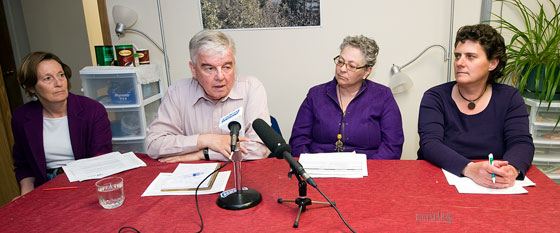
"People who need emergency shelters, people who need transitional housing are our most vulnerable members of our community and ... we are seeing very little being done for this population,” Patricia Bacon told a news conference Monday.
Bacon is the executive director of Blood Ties Four Directions and a member of the coalition's housing task force.
The coalition commended Blood Ties for its Tiny House initiative, which is expected to house one person by July.
The report also says the Yukon government is reportedly in discussions with the Salvation Army to expand its emergency shelter services and possibly other housing options.
The housing strategy outlined a need for more transitional housing and supportive housing until the purpose of the shelter, as an emergency resource, is restored. The coalition found the shelter is often over-capacity.
Marilyn Wolovick, the executive director of the Many Rivers counselling service and a member of the coalition's housing task force, said the shelter has 30 to 40 regulars every night.
The report says little to no action has been taken on a youth shelter. The coalition called for funding for a permanent youth emergency shelter, for the shelter to be available to youth under 16, that its location be easily accessible (a downtown spot was suggested) and that it's not attached to an institution that may
discourage youth from seeking assistance.
The coalition also identified a need for safe emergency shelter space for women and families.
No action has been taken thus far, but the report says discussion between the government and the Salvation Army could result in better options.
"There are often people who are inebriated (at the shelter) and there are issues around safety for women and children,” said Wolovick.
The progress in transitional housing is similarly limited.
The coalition does commend the City of Whitehorse for changing the bylaw to allow hostels and boarding houses in more areas of the city.
But no action has been taken to provide incentives to create more hostels and boarding houses.
No information was provided about any progress to provide community support workers to residents of the Yukon's social housing units, which include budget hotel rooms throughout the city.
The coalition contends that community workers would reduce the number of evictions and the overuse of emergency shelters.
Last year's housing strategy outlined a need for transitional housing targeted at women, street youth and people leaving correctional centres, drug and alcohol treatment centres, mental health facilities or youth in care facilities.
While the progress report notes that the Yukon government has committed $4.5 million for a second-stage housing project at Kaushee's Place, it notes that no information on a construction start date has been released.
No information was received regarding the development of transitional housing for people leaving institutions or extending youth emergency shelter stays for up to six months to ensure a better transition to more stable housing.
Blood Ties' housing navigator does provide assistance with housing applications, rental and tenant guides and housing searches, the report says, but it's one of the only organizations in the city with an employee dedicated to this purpose.
Bacon called the situation disappointing.
"We're looking at coming into another summer where housing supports and options for the most vulnerable, the most marginalized people in our community are being ignored, where there are no options for them,” she said.
"We are calling on our government and our elected officials to take a leadership role on the housing action plan that has been put forward more than a year ago.”
Bill Thomas, a co-chair of the anti-poverty coalition, said the task force is also disappointed in the failure of certain groups to provide progress updates for the reports.
While the City of Whitehorse, various NGOs, the Departments of Community Services and the Women's Directorate all provided updated information, the Departments of Justice and Health and Social Services did not provide any information even though they were given more than two months to provide it.
Health and Social Services did not respond to queries this morning regarding its failure to provide information.
While the task force may be disappointed with the Yukon government's action or lack thereof, the city, it feels, is doing its part.
Thomas said the city has been limited in its capacity due to restrictions in the Municipal Act, but he understands there are plans to amend some sections of it.
Asked about the $13 million in unused federal funds earmarked for housing, the task force expressed it's continued frustration with the situation.
Wolovick said it's disappointing when there's such an obvious need for that funding to be used, that the government continues to sit on it.
On June 4 the section of the progress report dedicated to long-term supportive housing will be released.
The section on rental housing and affordable housing will be released the following Monday, June 11.
See related story and letter.
Comments (1)
Up 0 Down 0
Iccycle on May 29, 2012 at 2:43 pm
Ecxellent ... a few more studies and that should do it. We have to be absolutely sure there is a housing problem before we move forward with moving forward. Getting the Gov't involved is a great idea. That should do it for sure ... excellent plan.