Major overhaul urged for teachers program
A review of the Yukon Native Teacher Education Program (YNTEP) is suggesting the program be dismantled, rebuilt from scratch, and run directly by Yukon College.
By Ashley Joannou on June 29, 2012
A review of the Yukon Native Teacher Education Program (YNTEP) is suggesting the program be dismantled, rebuilt from scratch, and run directly by Yukon College.
B.C. professors Thomas Fleming and Colin Chasteauneuf spent the past year studying the 23-year-old YNTEP program. They gathered data from more than 100 questionnaires and about 80 interviews with people around the territory.
What they found was a program that, after more than two decades, does not have a clear identity and should be more closely integrated with the college.
"The complete integration of YNTEP is long overdue,” the report reads.
"It is time to dissolve all the old program structures in the interest of flexibility, responsiveness, and efficiency, as well as to dismantle whatever co-ordination and governance supports remain.
"No good is served in preserving YNTEP as an entity socially and psychologically removed from other educational programs and structures at Yukon College, and one that sometimes makes students feel alienated.”
The 92-page report examines the YNTEP program, which began in 1989 as an effort to get more Yukoners of First Nations descent teaching in Yukon classrooms.
It is the first report of this kind to be completed in the program's history.
The elementary teacher program was acquired from the University of Regina. Graduates receive a University of Regina Bachelor of Education degree, making them eligible to work in both the Yukon and Saskatchewan.
The original incarnation was put together in about five months.
What was left was a "very unusual situation,” Fleming said Thursday from outside Victoria.
The territorial government provided the money, Yukon College provided the space and the University of Regina was responsible for the degree.
"The college didn't really have any leverage over the program ... essentially, they weren't in charge of the program,” he said.
"Government, once they had signed off on the funding, was also not in charge of the program, so you have a situation where the program is being supervised by an agency 2,700 miles to the south that is essentially delivering a pre-packaged set of courses.”
The authors suggest a Yukon-based program would be much more suitable going forward.
"It would probably be far simpler for these folks to begin from scratch and begin to identify a teacher's education program based on Yukon values, based on Yukon heritage,” Fleming said.
Yukoners are very proud to have their own education program, he said.
"The people we spoke with basically said, ‘we can do whatever we have to do up here; we can create our own programs, we can make better programs than we can import.”
When the program arrived in the territory, only one of 435 teachers in Yukon schools was of First Nations ancestry, despite the fact that First Nations people at the time comprised about one quarter of the Yukon's population.
That number has grown to 42 in 2012.
It remains to be seen whether the college will in fact completely take over the program.
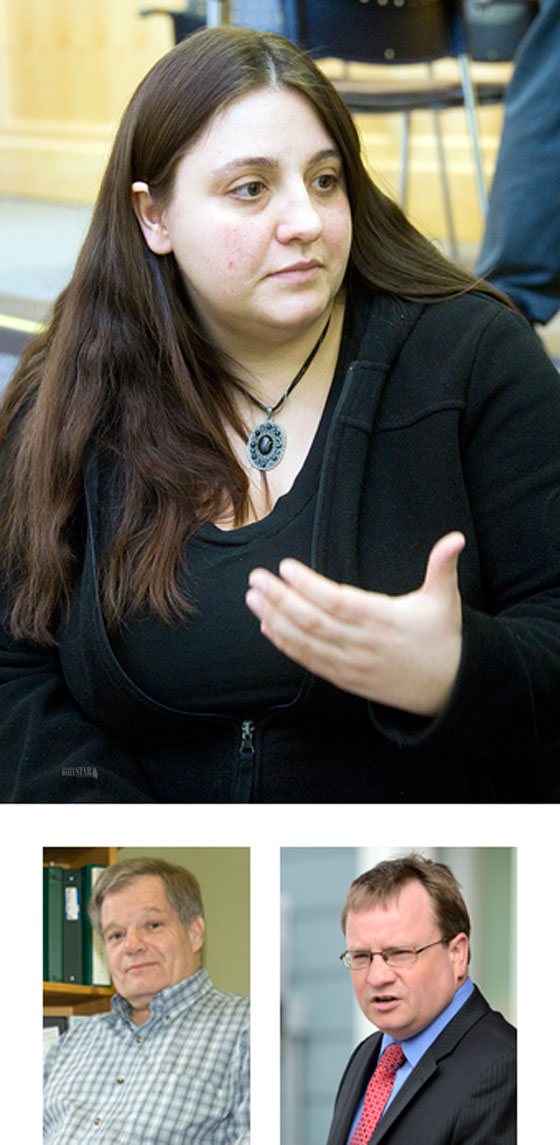
"Whether or not we are going to tear the whole program down and start over remains to be seen,” Dr. Bill Dushenko, the college's vice-president academic, told the Star Thursday.
The college is forming a review action committee to study the report's recommendations and determine the next steps.
"Most certainly, we do want to integrate the program more closely with Yukon College,” Dushenko said.
"The program has operated fairly autonomously over the past 23 years, and that might point to some of the challenges that developed over the years with respect to scope and creed.”
The lack of a clear identity, particularly when it comes to the program's cultural component, was also highlighted in the report.
"The cultural component of the current teacher education program is presently mired in what can only be described as confusion, discord, and disappointment,” it says.
"It is also saddled with an agenda for cultural and linguistic preservation that, in our view at least, cannot be achieved by any teacher education program.”
Tosh Southwick, the college's director of First Nations initiatives said this is a concern she has heard before.
"It's confusing for students, it's confusing for partners,” she said.
"We've got all these different expectations out there.
"Nobody's really said that it's the role of YNTEP to integrate culture into the classroom, nobody's really said it's the role of YNTEP to revitalize language and culture, and if that's what we're saying now, then we need to build a program to do that.”
The program also has some public image issues to combat.
"The perception was that all of the graduates that came out of the program were substandard, and nothing could be further from the truth,” Dushenko said.
"We've had some excellent students through that program; granted, like any program, there are students who probably aren't as strong as others.”
"There is a longstanding stigma that if a program has the word ‘native' in it, there is automatically an assumption from some people that it is not as academically rigorous,” Southwick said.
"We are trying to overcome that in a number of programs, not just YNTEP.”
No new students were admitted to the program for this September, to allow time for the report to be reviewed.
At this point, there is no definitive timeline for when that review might be completed, Dushenko said.
"Really difficult to say when the program would be launched again.”
For now, everyone involved in the program is concentrating on looking forward.
Education Minister Scott Kent, whose department will be represented on the committee, said today he is in the middle of reading the report.
"From a department perspective, I can say that we are supportive of the review process and look forward to working on the committee going forward.”
NDP MLA Jim Tredger, a former school principal, called the report an "excellent conversation starter.
"I think that it is time, and we have the skills and the expertise to have a made-in-the-Yukon program. The package from the U of R is a good starting point.”
The NDP public education critic did express some concern over funding for any new program run by the college.
"The idea of a stand-alone program meant that it received funding through thick and thin ... so that it didn't get lost in the college,” he said.
"Because the directed funding (from the Yukon government) was happening, it was maintained whether other programs were cut or not.”
The first meeting of the new action committee will likely be in August.
Comments (4)
Up 0 Down 0
Yukon and On on Jul 3, 2012 at 8:29 am
To anonymous,
I attended both college prep and completed a Certificate of Science through the Yukon College and wholeheartedy disagree with your comment above. In my experience, the instructors were hard-working and extremely dedicated. They went out of their way to help those of us who were committed to learning. I actually found that when I got to University, I was much better prepared for the second year science courses I attended than most of the students who had completed their first year at the University.
As for the YNTEP Program, the focus should be on producing quality teachers and not just filling quotas. There is too much at stake for this to be a numbers exercise.
Up 0 Down 0
Billy Polson on Jul 1, 2012 at 5:06 pm
anonymous....can't wait for next weeks rant...apply yourself and you too will have a certificate...
Up 0 Down 0
anonymous on Jun 30, 2012 at 11:26 am
As someone who works at the College, I can say that there are many problems there, not just this program. Unfortunately, the leadership of the institution is not really interested in solving problems, just in public relations efforts aimed at convincing people that everything is fine.
Up 0 Down 0
anonymous on Jun 29, 2012 at 9:29 am
"There is a longstanding stigma that if a program has the word ‘native' in it, there is automatically an assumption from some people that it is not as academically rigorous,” Southwick said.
Here is something that is going to blow your mind: When they hear the words "Yukon College" they automatically think it is not academically rigorous and they're right...it's not. Can say that from experience. Yukon College needs to start from scratch, not just this program. Hire some instructors who can actually TEACH! I sometimes want to march into the admissions office and demand a refund! That is how bad my experience was.