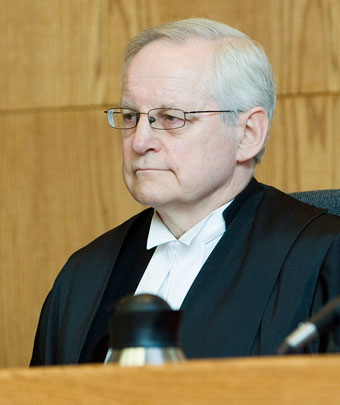
Photo by Whitehorse Star
Supreme Court Justice Ron Veale
Photo by Whitehorse Star
Supreme Court Justice Ron Veale
A former surveyor's assistant ordered to pay back $600,000 received from the territorial workers' compensation board has been granted a new hearing by the Yukon Supreme Court.
A former surveyor's assistant ordered to pay back $600,000 received from the territorial workers' compensation board has been granted a new hearing by the Yukon Supreme Court.
The most recent decision is the latest in a long series of battles between the board and Ashley Byblow related to his ability to work.
Byblow, who is currently in his early forties, had seasonal employment as a surveyor's assistant on Aug. 3, 1994 when he slid down a steep gravel hill injuring his head, jaw, left knee, hip and wrist, documents say.
The board accepted the claim that year and Byblow began receiving benefits until Dec. 31, 1994, when he was deemed fit to return to work by a neurologist.
He worked as an assistant manager from April 1996 to March 1999 for a finance company.
In June 2001, a neurosurgical consultant for the Head Injury Unit at the British Columbia Workers' Compensation Board reviewed Byblow's file.
That doctor concluded Byblow "sustained a moderately severe brain injury as a result of the industrial accident which occurred on August 3, 1994.”
The board accepted the doctor's report and determined that his claim should be reopened.
Byblow was given $164,640 in retroactive pay as well as continuing monthly payments.
It was later decided that he was unemployable due to his compensable head injury.
The next year, a second doctor was brought in by the board as part of a file review.
This neuropsychologist concluded that while Byblow "acquired a mild level of cognitive and emotional dysfunction as a result of the compensable accident of 1994,” his impairment was neither significant nor even moderate.
The doctor also reported that Byblow "was intentionally attempting to appear more impaired than he truly is.”
In May 2009, two investigative specialists hired by the board travelled to Westbank, B.C., where Byblow now lives, to conduct surveillance.
Based upon their report and the medical reports obtained since 1994, the director concluded that Byblow had been providing health care professionals and board staff with false and misleading information.
Byblow appealed and the appeal tribunal disagreed with the fraud charge.
Instead, the tribunal found that the Yukon Workers' Compensation Health and Safety Board should never have reinstated Byblow's claim back in 2001.
Despite being cleared of the fraud accusations, Byblow was still required to pay back most of the money, the tribunal ruled.
That was when Byblow applied for a judicial review of the decision.
In his decision made public last week, Supreme Court Justice Ron Veale said the appeal tribunal did not clearly state its basis for ordering the money be paid back.
Without the proper analysis of various policies related to recovering money, it is impossible to judge the reasonableness of the tribunal's decision, the judge said.
"As the tribunal has rejected the finding that Mr. Byblow committed fraud by providing false and misleading information to health care workers and board staff, it must address the recovery policy in a transparent and intelligible way,” the judge said.
Veale also criticizes the tribunal for gathering more information on the case from the Canadian Revenue Agency after the oral hearing in August 2010 had already taken place.
"The usual procedure when a tribunal receives additional information after a hearing is to provide the information to the parties and allow further evidence and submissions,” he said.
Veale said the CRA documents are a small part of the evidence the tribunal relied on but go directly to Byblow's credibility, which is at the root of the tribunal's decision.
"It is not for this court to speculate on whether this is a case where Mr. Byblow's review of the documents and further evidence from him or submissions by his counsel may or may not affect the result,” the judge said.
"The possibility that the 37- page decision considered so many other medical opinions and facts that the tribunal may not change its decision is simply not sufficient to answer such a significant procedural flaw.”
Byblow's lawyer had requested that the judge make a final ruling in this case rather than send it back to the appeal tribunal.
But Veale said that was not something he was comfortable doing. He said the case is not cut and dry, and he cannot say for sure what the tribunal will decide when the case is reheard.
There is no indication in Veale's ruling when the new hearing is to take place.
In order to encourage thoughtful and responsible discussion, website comments will not be visible until a moderator approves them. Please add comments judiciously and refrain from maligning any individual or institution. Read about our user comment and privacy policies.
Your name and email address are required before your comment is posted. Otherwise, your comment will not be posted.
Comments (1)
Up 0 Down 0
JuneJackson on May 7, 2012 at 9:41 am
How on earth do people learn how to milk the system out of this much money? I would really like to get on this gravy train.
I assume we'll be paying for his lawyers too?