Crucial highway link to the South restored
The Alaska Highway reopened Monday evening near Rancheria following the completion of a road detour around the substantial washout at Canyon Creek.
By Chuck Tobin on June 12, 2012
The Alaska Highway reopened Monday evening near Rancheria following the completion of a road detour around the substantial washout at Canyon Creek.
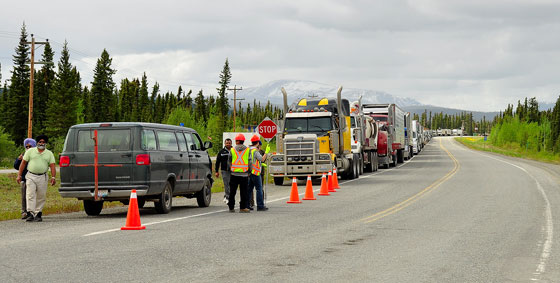
Northbound commercial trucks stranded at the highway lodge since the washout occurred last Thursday night were the first to be taken over the single-lane detour beginning at 7:30 p.m.
They were followed by private vehicles, according to government officials.
Once Rancheria was cleared, some 200 commercial trucks waiting in Watson Lake to come north were released between 8:00 and 9:30. They moved as one big convoy behind a pilot vehicle that stayed with them until they'd passed through the detour at Canyon Creek.
Larger industrial vehicles followed. Then private vehicles and RVs were released in groups behind a pilot car.
Southbound traffic backed up in Teslin was released at about the same time as vehicles waiting in Watson Lake to come north.
Government spokesman Matt King explained today that now that the congestion has been cleared at the choke points, pilot cars are no longer being used, except to guide vehicles through the detour.
King said highway crews are estimating they will have a Bailey bridge in place and an upgraded two-lane route flowing around the Canyon Creek washout as early as Thursday.
The Campbell Highway reopened at about noon today, though the Nahanni Range Road into the Cantung Mine remains closed, along with South Canol. The North Canol hasn't yet been opened for the season.
The North Alaska Highway between Haines Junction and Destruction Bay was opened Saturday.
Al Nixon, assistant deputy minister of the Yukon's transportation division, said engineers are flying into the Nahanni Range Road today to assess several washouts.
Communications officer Aisha Montgomery of the Yukon's Emergency Measurers Organization said this morning from Watson Lake the release of vehicles went fairly smoothly.
RV travellers, she said, were asked if they minded staying behind for the night just to reduce traffic. Many agreed to, though most were cleared out by late this morning.
All indications from traffic coming south through Watson Lake today is that the highway is fine, but for what is being called a "burp” at Canyon Creek, she said.
Meanwhile, Montgomery added, efforts are continuing to ensure that the needs of flood victims from Upper Liard and Lower Post, B.C. are being met.
She said 177 received some form of assistance from the emergency reception centre established in Watson Lake to assist stranded highway travellers and flood victims.
Approximately 25 people had registered for overnight accommodations last night but only eight showed up, she said, suggesting many probably took advantage of the Alaska Highway's reopening up.
The Daylu Dena Council of Lower Post has established emergency provisions for victims of the Kaska community on the B.C. side of the Yukon-B.C. border, a stone's throw from Watson Lake, she said.
Montgomery said the government is encouraging Upper Liard residents who were forced to flee their homes to register with emergency services in Watson Lake.
It's important people understand services like the provision of food and accommodations are available for flood victims, she said.
Montgomery said many went to stay with family and friends, but that was three days ago, and some may be wanting to make other arrangements.
The number for the emergency centre in Watson Lake is 867-536-2232, she said.
Hydrologist Ric Janowicz of Environment Yukon has described this spring's flood conditions across the southern Yukon as the product of a perfect storm, combining above average spring rains and above-average snowpack in the mountains.
The amount of water busting over the banks of rivers everywhere is unprecedented, he said during a technical briefing Monday.
Janowicz said this morning the Liard River at Upper Liard has receded a total of 3/4 of a metre or 77 centimetres since it peaked Sunday morning at an all-time high of 1.9 metres – more than six feet – above what is described as the beginning of the flood stage.
The previous high for the peak was recorded at 90 centimtres in 1972, he said.
Janowicz said the river will likely take two or three days to recede back to or below the flood stage level.
The volume of rain expected in the area in the next couple of days is not likely to prevent the river level from falling, though they may slow the drop, said Janowicz.
Twelve residents from Upper Liard were removed early Saturday shortly before the river breached the flood dike.
Eleven homes were under and remain under more than a metre of water.
Government spokesman Elaine Schiman explained this morning all hands are currently focused on co-ordinating the response to the emergency situations that have occurred over the last week.
Once the emergency subsides and officials turn their focus to restoration, the territorial cabinet will certainly be considering whether to provide a financial relief program for flood victims, as it did in 2007, she said.
See related coverage
Be the first to comment