Photo by Vince Fedoroff
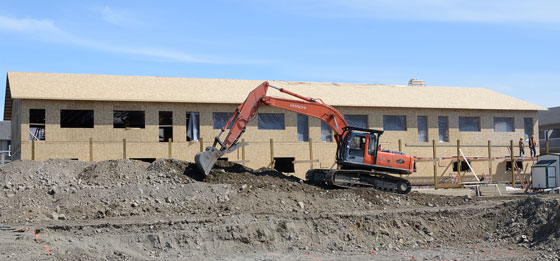
A CHANGING MARKET – A growing supply of new housing is helping real estate prices level out, says the Yukon Real Estate Association.
Photo by Vince Fedoroff
A CHANGING MARKET – A growing supply of new housing is helping real estate prices level out, says the Yukon Real Estate Association.
The Whitehorse housing market is softening, says the president of the Yukon Real Estate Association.
The Whitehorse housing market is softening, says the president of the Yukon Real Estate Association.
Val Smith said this week she feels it's too soon to talk about just how far the average price has fallen, but there has been a downward trend that began surfacing last fall for all categories of housing.
Increasing supply, a jittery world economy and tighter lending regulations are all contributing, Smith told the Star.
She said more than anything, it's a rebalancing of a hot housing market in the Yukon which took off in 2002, following the uneventful days of the late 1990s.
The last 10 years have been a sellers' market, when it wasn't unusual to see a property sell above the asking price as potential buyers lined up to bid against each other, with demand outstripping supply, Smith said.
These days, said the real estate president, it's a buyers' market, and buyers appear more tempered in their approach.
"The market is adjusting price levels,” she said.
"Nobody is losing money, unless per chance you bought in the last six months to a year ... and even then not much.
"I would simply say we are rebalancing and coming back to a normal market place with a reasonable amount of supply.”
Smith said the number of units available today for occupancy within 90 days is twice or more the number available at this time last year.
While the first phase of the new Whistle Bend subdivision won't be ready until late this year "at the earliest,” it's not yet a major factor in today's supply and demand curve, she said.
Smith said it is a factor, however big or small, when it comes to potential homeowners considering their options, when they're considering what they're willing to pay today, and what the market conditions might be like when Whistle Bend opens up.
The market in the last decade has created an unsustainable level of expectation when it comes to profit from real estates sales, she said.
One national bank recently predicted annual growth in the real estate market will continue at a slower but more sustainable pace of about two or three per cent a year, she added, but not the 10 or 15 per cent Whitehorse has seen in recent years.
A case in point she knows of involves one unit purchased in November 2010 for $247,000.
The owner listed the home a year later last November for $324,000, hoping to sell for $319,000, but eventually accepted $309,000.
Yukon-wide real estate statistics show the number of listings has jumped over the moon this year, compared to May 2011.
A year ago, there were 111 residential listings in all categories, houses to condos, not including private sales and sales through the PropertyGuys organization.
Today there are 261 residential listings, up by 150, or significantly more than double what there was last May. Whitehorse accounts for 213 of those listings.
PropertyGuys has another 112 clients selling their homes, 80 of whom are in Whitehorse, PropertyGuys proprietor Pat Shaw confirmed Thursday.
In fact, in the usually slow months through the dead of winter, there were 173 listings with Yukon real estate agents in January this year, compared to 72 in January 2011, according to the statistics.
City of Whitehorse records this week show there are 178 residential developments of all sorts in the works, but primarily units in multiple housing developments, like condos and townhouses.
Some of the 178 have been included in the listings, like the condos which are being pre-sold in the larger downtown developments like Mah's Point and River's Reach, but not all of them, Smith said.
She said those getting into the market as either a buyer or seller need to understand there is a difference between the number of units listed, and the number available in the traditional 90-day window.
Last week, Smith pointed out, she did a survey of the 58 residential listings in Porter Creek. Seventeen were available within 90 days, she said.
The spur of condominium developments has been a growing factor in the market place, going back to 2005, she added.
Also noticeable in recent years was the number of Yukoners, not newcomers to the territory, who were buying or building real estate as an investment, she said.
"That especially has been manifesting itself in the market place.”
Smith said with lending guidelines changing, it's getting tougher or more expensive for Ma and Pa to borrow money for investment purposes.
But all in all, she said, the downward shift in real estate prices is best described as a rebalancing or market correction, influenced in part by a growing supply.
Nobody knows what the future will bring, acknowledged the association president.
Smith dismissed any suggestion or notion the bubble is bursting, the sky is falling, or that those who have pre-bought condos are going to walk away from their deposits.
Conjuring up such a scenario would be, at the very least, an extremist view of the state of the real estate market, she insisted.
Smith said while the uncertainty of the global economy plays into the equation to some extent, it has to be emphasized the economy of the Yukon has remained robust, and still is.
• Going back to 1995, the average price for a house in Whitehorse was $153,067, according to figures from the Bureau of Statistics;
• The price dropped by a couple of thousand dollars but basically flatlined through the late 1990s to 2001, when the average price was at $152,674;
• The very next year, the average price of a house in Whitehorse jumped by $8,400 to $161,054.
• By 2005, the price hit $214,712, or $53,000 more than three years earlier when the climb began.
• From 2002 through to 2011, statistics show the average price jumped year after year after year, except for just one year.
• By the end of 2008, the average price was $325,352, slightly more than double the price in 2002.
• In 2009, in the wake of the global economic meltdown, the price of a house in Whitehorse slipped to $322,763, the first dip in eight years, as slight as it was.
• But the market returned with a vengeance in 2010 – three years into the drought of urban lots – when the average price jumped by some $53,000 in a single year, up to $375,386.
• The record one-year hike, however, was last year, when the price jumped by $59,000 and broke the $400,000 barrier for the first time, with an average home in Whitehorse selling for $434,694.
• By the end of September 2011, the average price had reached $455,700. It fell by $23,000 over the next three months to end December, when the average price was sitting at $432,60, according to the bureau.
Real estate statistics for the first three months of this year are not yet available.
In order to encourage thoughtful and responsible discussion, website comments will not be visible until a moderator approves them. Please add comments judiciously and refrain from maligning any individual or institution. Read about our user comment and privacy policies.
Your name and email address are required before your comment is posted. Otherwise, your comment will not be posted.
Comments (4)
Up 0 Down 0
Billy Polson on May 28, 2012 at 2:21 am
It will be a while before prices come down to anything folks can safely/justifiably afford. We'll watch those "higher end" houses drop from from half a million dollars....it is pretty quiet in the mineral world this year. Few investors, showings weren't as good as all the hype suggested....I feel bad for those who paid ridiculous amounts for a house. They can thank the ol' mineral spin.
Up 0 Down 0
Guncache on May 22, 2012 at 12:13 am
Well you will soon be able to purchase your "dream lot" at Whistle Bend. Have you had a look at the area yet? It is a "beautifully flattened" gravel pit. Please bring your own trees as this was a clear cut operation. Thousands of loads of gravel had to be brought in to raise the elevation. Restrictions will be super tight and don't be surprised if your long box crew cab truck sits on the sidewalk because of garage restriction distance from the sidewalk. The city will be nice enough to tell you what color your house can be. Buyers, buy your house elsewhere in Whitehorse and not in Whistle Bend. Even Copper Ridge has big lots compared to this gravel pit. Nice going COW.
Up 0 Down 0
June Jackson on May 19, 2012 at 1:00 pm
Re: Jackie Ward.. - not that i am a religious person..but even Jesus Christ said beware the money lenders..no one listened.
Our governments, including Bucky borrow money from the banks.. the banks then own the governments..
I don't understand how the housing market is slumping, stats say we have 500 new people in the territory.. did they all go on our very generous welfare program? where are they living?
Up 0 Down 0
Jackie Ward on May 18, 2012 at 10:12 am
A buyer's market?, lol. If you had any clue you would be selling now. Interest rates are going up. And banks approve anyone who walks through the door because their risk has been put onto the backs of you and me, the tax payer. Anyone with half a brain would know something is fishy with that. So if a crash does come, banks won't lose a dime. How as a society are we allowing this? You won't care until you lose everything you have and are living on the street. All because you trusted the system.