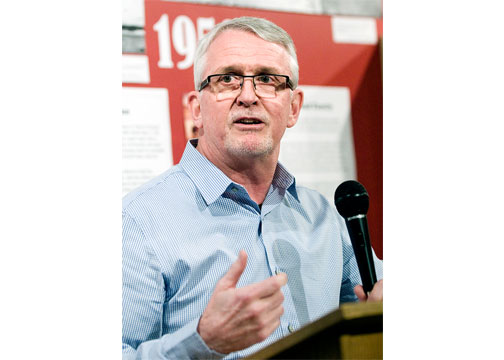
Photo by Whitehorse Star
Pictured Above: DAVID MORRISON
Photo by Whitehorse Star
Pictured Above: DAVID MORRISON
The third turbine at the Aishihik hydro facility came in over-budget by $5 million – 57 per cent.
The third turbine at the Aishihik hydro facility came in over-budget by $5 million – 57 per cent.
"Needless to say, we were really not happy,” Yukon Energy president David Morrison said in an interview Tuesday. "And then we tried to figure out what went wrong.”
While the cost was initially estimated at $8.8 million, it's now jumped to $13.8 million, according to Yukon Energy's application for a 13-per-cent increase in electrical rates over two years.
Morrison, however, insists the cost of the new turbine and other recent capital projects by the publicly owned utility are not the driving the factor in the need for a rate hike.
Maintaining aging infrastructure to meet rising demand, which is requiring more diesel generation, are the primary reasons behind the rate application, he insisted.
Morrison said it must be remembered that normal capital costs approved by the Yukon Utilities Board are spread over 35 years.
Of the $13.8 million for the new turbine, Ottawa paid $5 million through its eco-trust fund.
The remaining $8.8 million is expected to be passed on to ratepayers through the application, though it was supposed to be a $3.8 million passed to ratepayers originally.
Even if the initial estimate had come in at $13.8 million, Yukon Energy still would have proceeded because the new seven-megawatt turbine makes financial sense, as it produces electricity at 12 to 13 cents per kilowatt hour, he said.
Morrison said the price of energy generated by diesel, on the other hand, is somewhere up over $30 cents a kilowatt hour these days.
Nonetheless, said the president, Yukon Energy did backtrack on the third turbine project to root out the cause of what he agrees was a substantial error in the cost estimate.
Yukon Energy, he explained, knew that excavating the new rock tunnel required for the turbine 100 metres below surface was going to be more expensive than thought, though that was not an issue.
Morrison said once the turbine had been ordered and the excavation work had been planned for, the corporation hired the international firm of AECOM to manage the rest of the project.
AECOM compiled the estimate, but when the three bids came back for installation of the turbine and completion of project, they were substantially higher than expected.
AECOM and Yukon Energy even went to a fourth company outside the tender process to get another opinion, and the price still came back substantially higher, said the corporation's president.
After AECOM did an analysis of its cost estimate, Morrison added, the company acknowledged the fault in estimating was theirs.
The third turbine has been on line since last Dec. 6, and has operated for a total of 2,530 hours to May 6.
Its advantage is in using less water to generate the same amount of energy compared to the two older units at the Aishihik plant – pound for pound, or litre per litre.
Yukon Energy records indicate the corporation consumed 500,000 litres of diesel fuel for its diesel generators from Nov. 1, 2011 to April 30, at a cost of $580,000.
In its rate application to the utilities board, Yukon Energy has asked for a 6.4-per-cent rate increase this year for all users, and another 6.5 per cent in 2013.
It has also asked the board to allow the rate boost to go ahead July 1 on an interim basis, until the board can make a decision on the application. The rate increase would be retroactive to Jan. 1, if approved.
Moving forward with an interim increase ahead of the hearing would mean less impact on consumers if the board does eventually approve the application and the rates are applied retroactively, says Yukon Energy's application.
The utilities board has not yet provided any direction regarding the request for an interim increase on July 1, though it has set a date of Sept. 17 to 19 to hear submissions on the application.
The Minto Mine and the Bellekeno Mine have already had a hike of 3.4 per cent as of Jan. 1.
Yukon Energy is asking for an additional 2.9 per cent to be applied July 1 on an interim basis.
In order to encourage thoughtful and responsible discussion, website comments will not be visible until a moderator approves them. Please add comments judiciously and refrain from maligning any individual or institution. Read about our user comment and privacy policies.
Your name and email address are required before your comment is posted. Otherwise, your comment will not be posted.
Be the first to comment